

Sitting atop the Cannibals list is a name I was quite frankly scared to do the leg work on. I can try to add suspense, but the title already gave away that we’re going to take a look at Adobe.
Adobe as an investment makes my palms sweat. The reason my palms sweat is the same reason that the stock is more than 60% down from its all time high of ~$688 back in late 2021. That reason: AI.
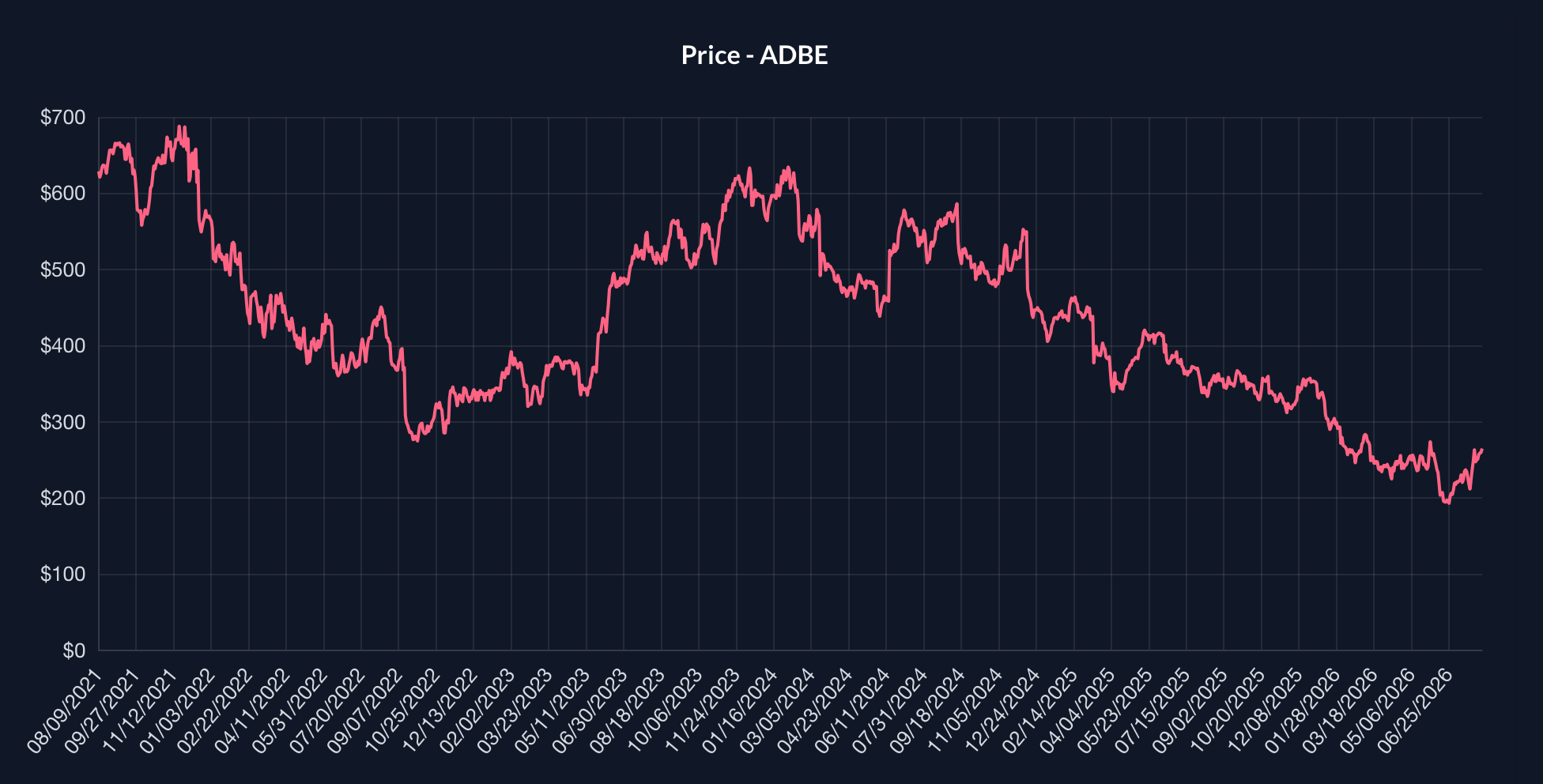
At roughly eleven times the cash it throws off, Adobe is priced for a business that has already stopped growing. Which makes it one of two things: a generational bargain because AI fear is overblown, or a classic value trap because AI really does hollow it out. Our quantitative screening cannot answer that question, only a deep dive qualitatively can.
The AI Question
If we look at Adobe through the Christensen lens we’d say that incumbents generally win sustaining transitions and lose disruptive ones. Bulls lean on generative AI being a sustaining change for Adobe while the bears call it completely disruptive.
Me, I say it’s both, and it splits roughly down Adobe’s customer base. Adobe doesn’t hand us a clean consumer-versus-enterprise line anymore (more on that reporting mess below), but think of it as two ends: the casual consumer, prosumer, and student on one side, and the professional and the enterprise on the other.
On the “cheap” consumer and prosumer side of the market, one might consider Adobe dead on arrival. Speaking from personal anecdotes I can say that whenever I need to make quick tweaks to an image, I’m on Canva. Whenever I need a flyer or a poster, or even something a bit unique it’s more likely that Gemini and ChatGPT are helping me out.
I’m not alone in this either. Just look around at the event posters for your local establishments. Nearly every one of them is using ChatGPT to get that made, it’s incredibly easy to tell.
This casual end is the slice most exposed to free AI tools. While I don’t expect it’d drop to absolute zero, I do think it’s on the safer side to assume that Adobe isn’t going to be the tool families reach for when editing their photos. That slice erodes. (Hold that thought, though, because when we get to the actual numbers, the group carrying most of those consumer dollars is growing faster than the professional one, not shrinking.)
On the opposite end of the market, the enterprise, they need the likes of Adobe. An enterprise cannot open up ChatGPT and say “make me a flyer.” They can’t open Midjourney and say “make me a commercial.” They can, however, open Adobe’s suite of products and utilize AI to speed up their overall delivery.
The enterprise moat that Adobe offers also comes with IP indemnification, a real benefit to the enterprise. Firefly is trained on licensed and public-domain content, Adobe Stock and openly licensed work and material whose copyright has expired, and Adobe offers enterprise customers an IP indemnity against copyright claims on the output of eligible Firefly workflows.
Other enterprise tools exist to go along with it. Adobe’s GenStudio is built to be the enterprise content supply chain. Its ending ARR grew more than 25% year over year, with marquee customers like Coca-Cola, and it now touts Brand Intelligence, contextual brand rules that AI agents can read to keep every asset on brand, a lock-in that could make it difficult to move away from.
There’s also the Experience Platform, plus Marketo, Workfront, and the recently acquired Semrush in the arsenal. Looking across the vast array of offerings, and looking at their growth, it leads me to think that a vast amount of the dislike for Adobe centers around Photoshop. I 100% believe that Photoshop will never be as great as it once was, but I do not think that Photoshop is a reflection on the future of Adobe.
What’s Actually Growing At Adobe?
When faced with a company that’s on shaky disruption ground I usually like to turn to the segment reporting. You can, quite easily, spot if that shaky ground is shaking them.
You’d think that’d be easy. Pull up Adobe’s segments, see which are growing, which are dying, tie it back to the bigger picture. Well, Adobe made that hard this year.
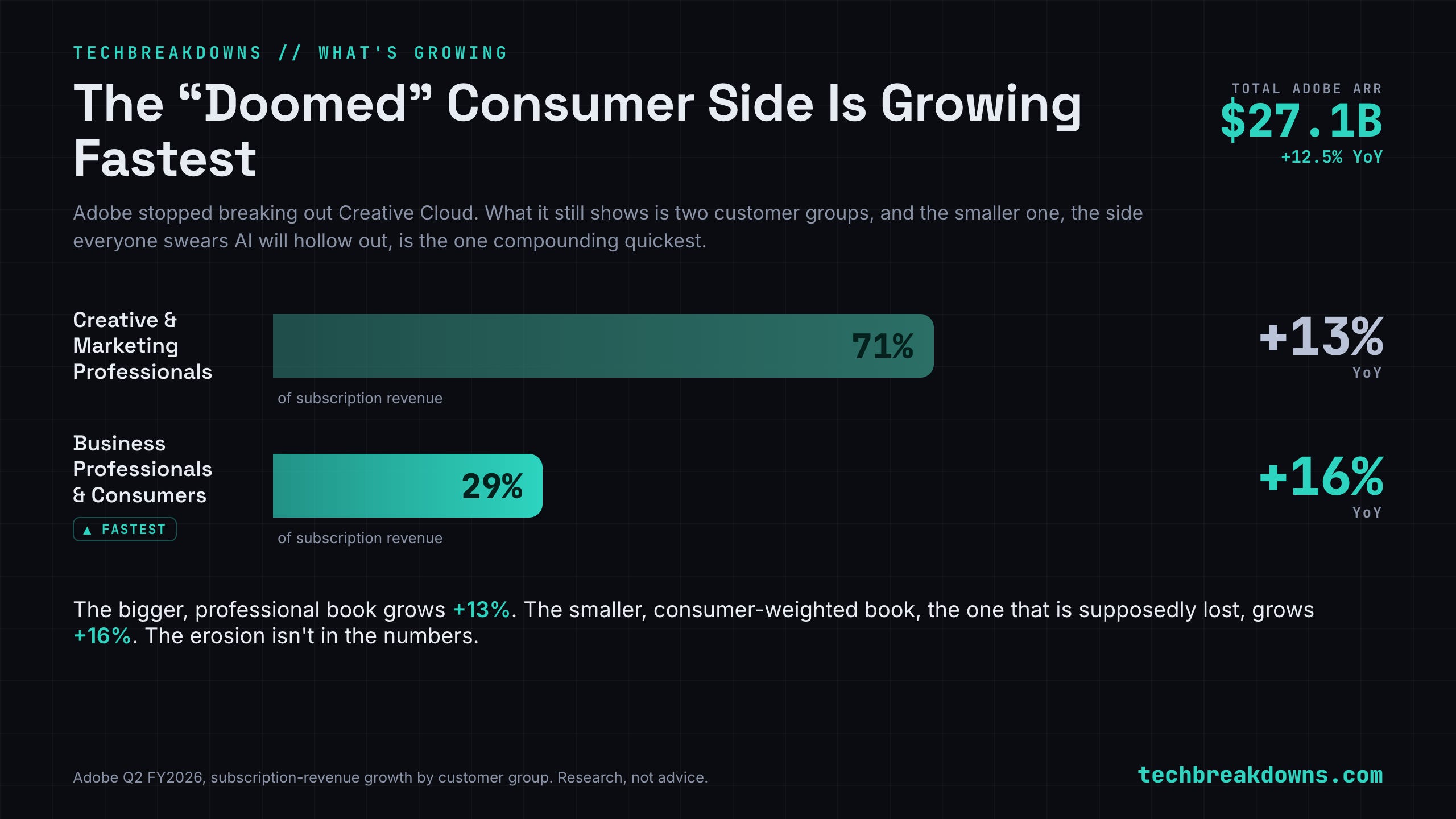
For a decade you could see Digital Media ARR, Creative Cloud, Document Cloud, the Experience business, each on its own line. Now, management has collapsed the whole thing. The Creative Cloud and Document Cloud split is gone, the three old segments are folded into one, and we get a single headline number: “Total Adobe ARR,” which grew about 11.5% to $25.2 billion exiting fiscal 2025, and $27.1 billion by Q2 of this year.
You can look at this in a couple of ways. There’s the cynical read: they stopped showing the numbers at the exact moment the market decided AI was going to kill Creative Cloud. Or there’s the more charitable read: the business is so cross-woven that the old lines stopped meaning so much. It’s probably a little of both, with the timing making it seem even more suspect.
What Adobe does still give us is two customer groups, both of which continue to show growth. In Q2 of fiscal 2026, their subscription revenue grew:
Creative & Marketing Professionals - about 13% Y/Y
Business Professionals & Consumers - about 16% Y/Y
(Those are customer groups, not segments. Adobe now reports a single reportable segment.)
Is there then anything shrinking at Adobe? Yes, there is, but it’s a legacy Publishing and Advertising business that fell 7% to $256 million, about 1% of revenue and freshly written down, plus a few low-margin services. All told, not worth much and effectively a rounding error in the grand scheme.
So we’re looking at a company that’s being priced for death, growing at 13% per quarter, where the only shrinkage we’ve seen has come from scraps they wrote off, and where the more consumer-weighted of the two customer groups is actually the faster-growing one.
The Bear Case: AI
The bear case that we’ve been dancing around throughout is the rise of AI. This would make sense if Adobe was standing still, but it’s not, it is actively selling the AI.
Adobe has a book of AI products, standalone tools and add-ons like Firefly and the Acrobat AI Assistant that customers pay extra for (paid Acrobat AI users more than doubled year over year).
Firefly has generated more than 22 billion assets, and the money is starting to show: Adobe’s AI-first ARR tripled year over year to more than $500 million as of Q2. People are paying for this, be it by credits, subscriptions, or an enterprise seat.
I’ve come to think of Adobe as the Switzerland of generative AI. It doesn’t matter if Google, Anthropic, OpenAI, or any other model is best, Adobe puts them in the app and charges for the workflow wrapped around them. Models are a commodity racing to zero, but the place and way that work gets done is not. Adobe currently owns that place.
Now let’s not mince things here, Adobe does face a lot of competition across its key areas. In the design space there’s Figma, the company Adobe tried and failed to buy for ~$20 billion before regulators killed the deal at the end of 2023. In the graphic design space, OpenAI can largely get quick jobs done as can Canva. Video editing has CapCut. Sending of emails and marketing tooling has hundreds of competitors touching each piece of the stack.
So, it’s not all smooth sailing, but Adobe is showing that the company is able to grow despite what seem like incredibly insurmountable headwinds.
The $25B Machine
Alongside everything we’ve spoken about, there’s the part that made Adobe the top stock on our Cannibals screener: buybacks.
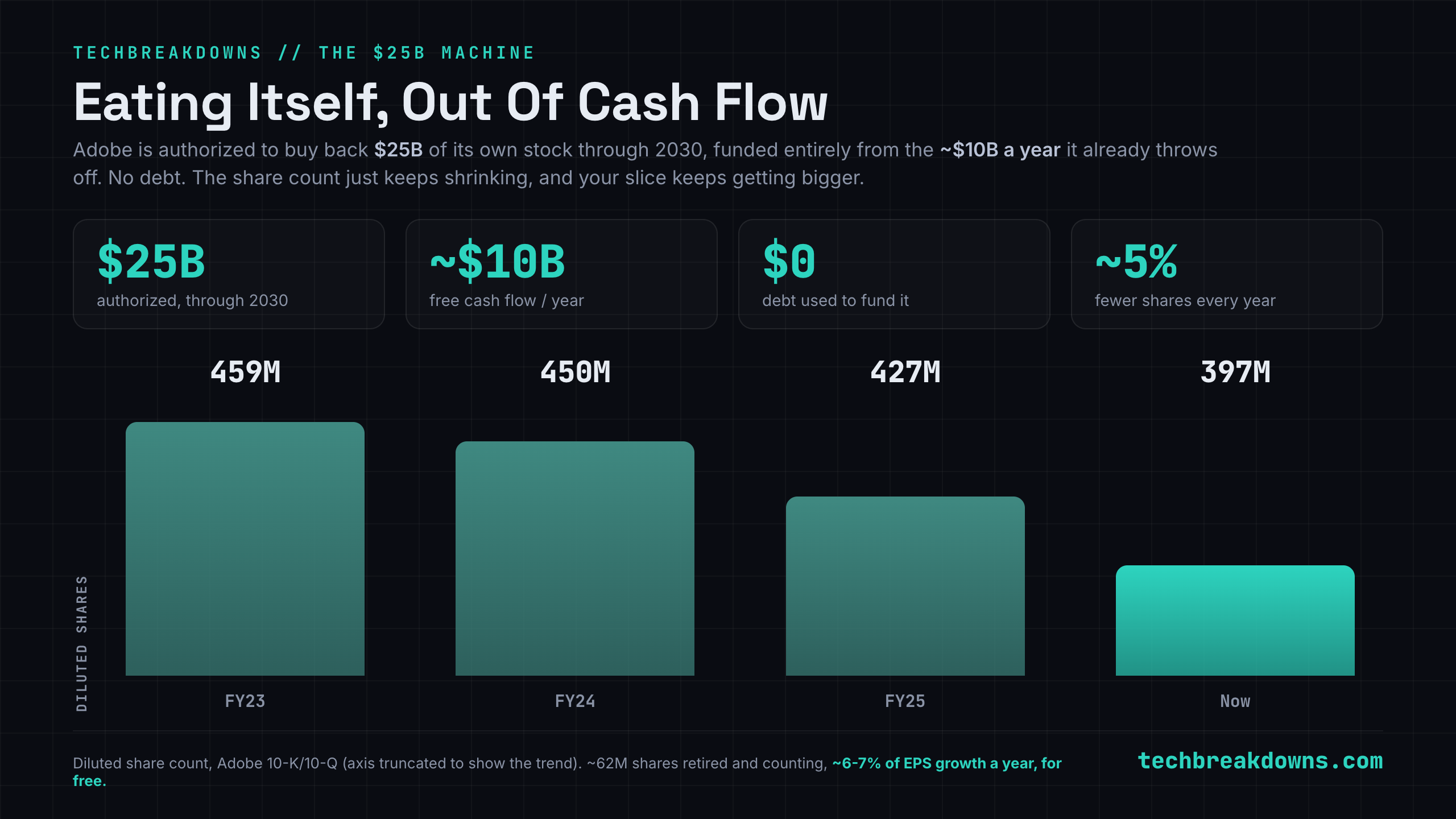
In April, Adobe’s board authorized a new buyback: up to $25B of its own stock, running through April 2030. Stacked on the program already running, that leaves about $26.8B of buying power authorized.
Adobe is worth about $105B today. A buyback of $25B is close to a quarter of the whole company. At around $265 a share, $25B retires roughly 94 million shares, and Adobe has about 397M outstanding.
Adobe needs to generate this cash though to be able to buyback the stock. Can it? Well, the company threw off about $10B in free cash flow last year. $25B is about 2.5 years of cash flows spread across a four year program. If things remain flat, Adobe generates $42B and gives back just $25B of it. No debt or financial engineering here, it’s purely funded by the printer.
Shrinking the count of your shares by close to a quarter ends up growing EPS by about a third, all without lifting a finger. Spread that over four years, that’s ~6-7% of EPS growth before Adobe sells a single new subscription.
The paradox of this whole thing... the cheaper the market makes Adobe now out of the AI fear, the more of itself each of those dollars can buy. The market’s hatred, while Adobe continues to grow, is doing the compounding for you.
The Numbers
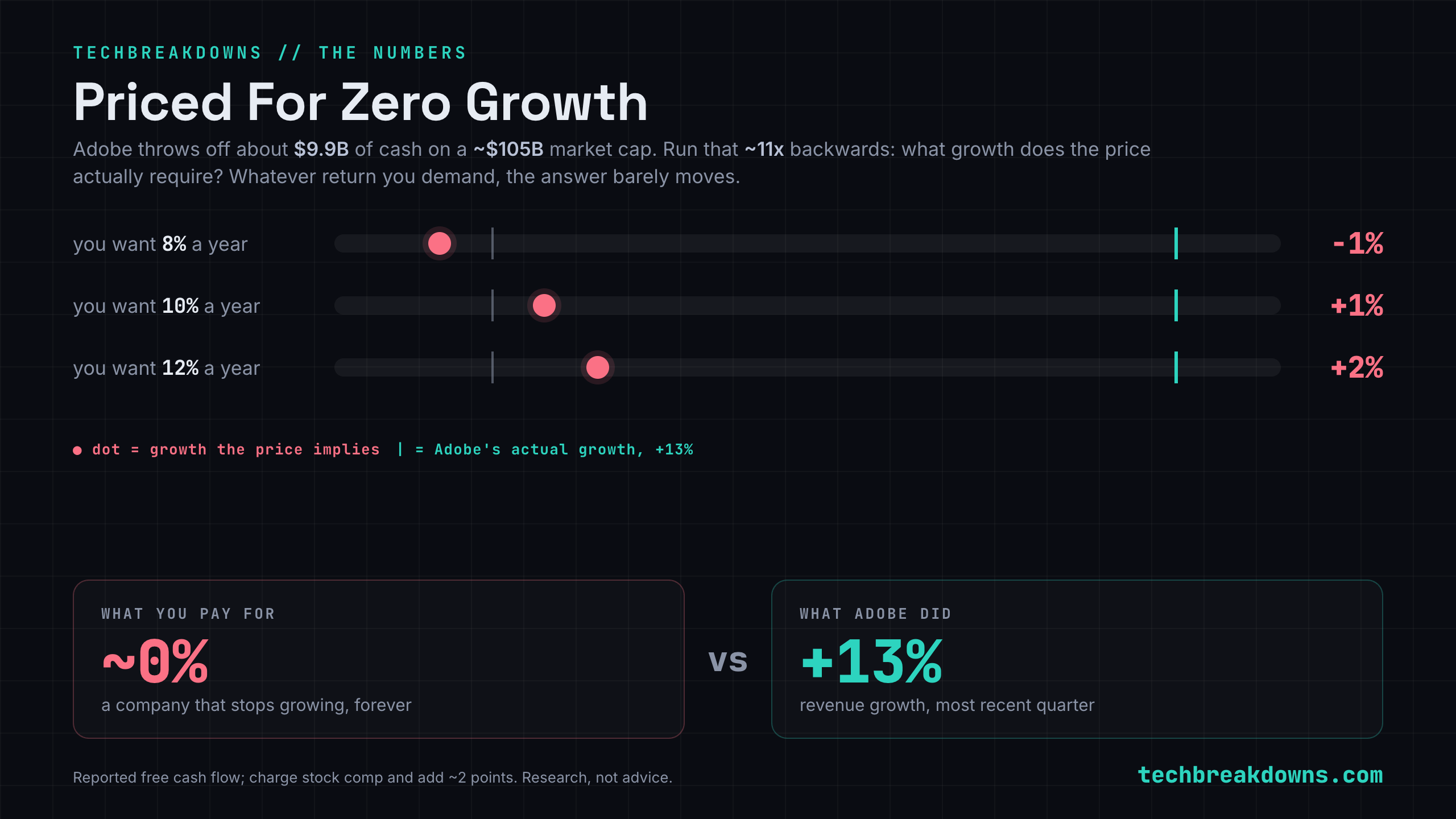
Let’s start with what the company throws off. Last year Adobe produced about $9.9B in FCF. The company carries essentially no net debt, so the whole business, worth about $105B as of close on August 7th, is priced against that cash directly. Divide one into the other and you’re paying roughly 11x FCF, or a hair under a 10% yield.
If we work that backwards, a stream of cash that never grows another dollar, and that you want a 10% return on, is worth exactly ten times that cash. Adobe trades at about eleven. So the price today assumes almost precisely zero growth, forever. If we factor in the stock-based comp (and you always should) the implied growth ticks up to ~2% per year.
So, we’ve got a price saying zero percent against a business that’s growing thirteen. The math isn’t a problem with this one, but let’s explore a little deeper anyway.
Our return will come from two engines: the cash flow per share growing, and the buybacks shrinking the share count out from under us. Adobe is retiring about 5% per year, net of the shares it hands out to employees.
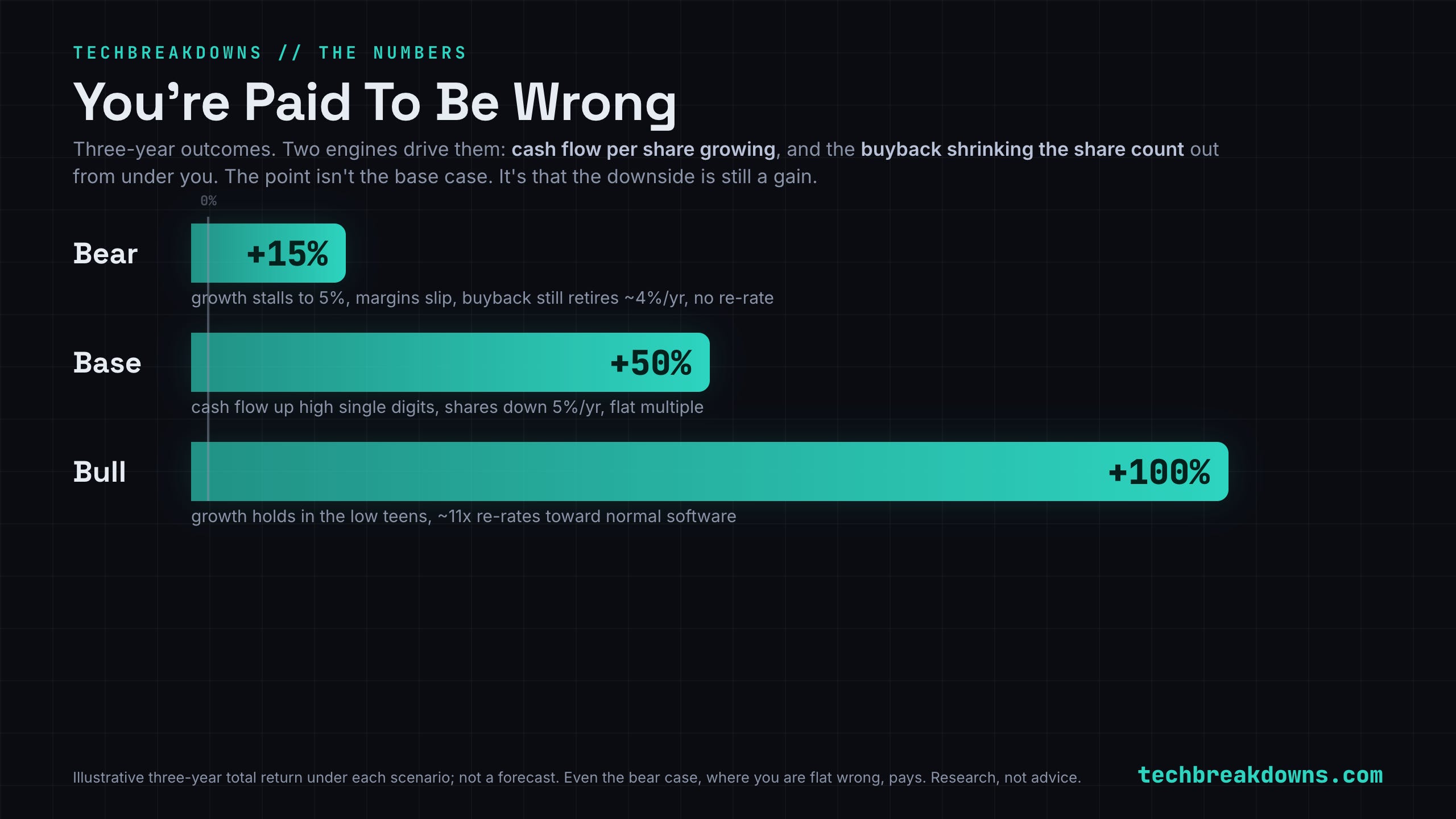
Bear case: the AI fear is half right and growth plummets to 5%. Margins end up slipping and cashflow doesn’t grow. The buyback still eats 4% of the shares. Cash flow per share still climbs due to stock retirement and we net a small gain.
Base: Adobe keeps on the same path. Cash flow up high single digits, shares down 5%. Cash flow per share compounds at around 14% per year, which on a flat multiple provides a 50% gain over three years and that assumes the market never hands back a single turn of the multiple it stripped off.
Bull: the AI products keep compounding. Growth holds in the low teens, and eleven times cash flow re-rates towards what quality software normally commands. That gives investors a double or better over the next three years.
The Call
Adobe is a buy. It’s going to be the first Cannibal we’re adding to the book and it earns the slot the way a cannibal is supposed to: a wonderful business that the market decided to hate, throwing off enough cash to swallow a quarter of itself while it waits for everyone to calm down.
The qualitative work says AI is a tailwind Adobe is monetizing. The quantitative work says you’re paying a price that only pencils if the company stops growing entirely. If we put those together, we end up with the exact setup this screen was built to find.
I won’t pretend though, for even a minute, that it’s the sleep easiest stock we could have picked. For that reason, I’m not backing up the truck, but will add to the name slowly (I’ll post when that happens).
Why not back up the truck though? Three reasons:
The low end being exposed: the casual creator is likely walking away
Adobe stopping segments at the precise moment it mattered most
The CFO who tied the buyback to Adobe’s “profitability and cash flows” left the company in June, with an interim in the seat right in the middle of the AI transition.
None of the three break the thesis, but all argue for buying in pieces and taking things slow.
I’ll be watching for:
Total Adobe ARR growth slipping below the high single digits
AI-first ARR stalling out
Buyback slowing down, or turning to debt to fund
If I see any of those, the story changes.
Until then: a wonderful, hated, cash-gushing business, eating itself at a funeral price. I’ll take it.
*Everything here is research and a model portfolio we track in the open, not personalized investment advice. Do your own work before you act.*