

The beauty of diving into a B2C company here on TechBreakdowns is that I can (usually) use it. I can get a feel for it. I can use their APIs and understand how some parts of the innards actually function.
Instacart is a company that I’ve not had the pleasure of using before, but that $CART ticker shows up on the Reinvestor list, so it’s worth a deep dive to understand if there’s any value there and what our returns could be.
Like always, we’re going to tell the story of the company. We’ll talk about Instacart’s products, what makes them stand out, and where the name could head in the future. Our premium subscribers can go even deeper with a look at the financials and the bull/base/bear cases for the company.
The Order
The part we all know, but that I hadn’t tried till I dived in, is Instacart’s order platform.
The premise is simple: it’s 4:30pm on a Tuesday afternoon and your fridge is bare. So, you open up the Instacart app and build yourself a little grocery basket. You go to checkout, Instacart reminds you of a couple of things you may have forgotten (based on learning for repeat users), and bam, it’s on your doorstep within an hour.
Much like ordering an Uber, it feels effortless. There is, however, a little bit more complexity to the grocery order than there is to the rideshare.
A single supermarket can hold 50,000+ unique SKUs. A lot of those SKUs are perishable. Product weights can fluctuate, items can expire, and the shelves are continuously picked over by other shoppers.
Instacart has to solve all of these problems, and they do so at a price. While you’ll have to forgive me for absolute numbers not being present, I did build the same basket in person, and online via Instacart from the same store to see what it would run me.
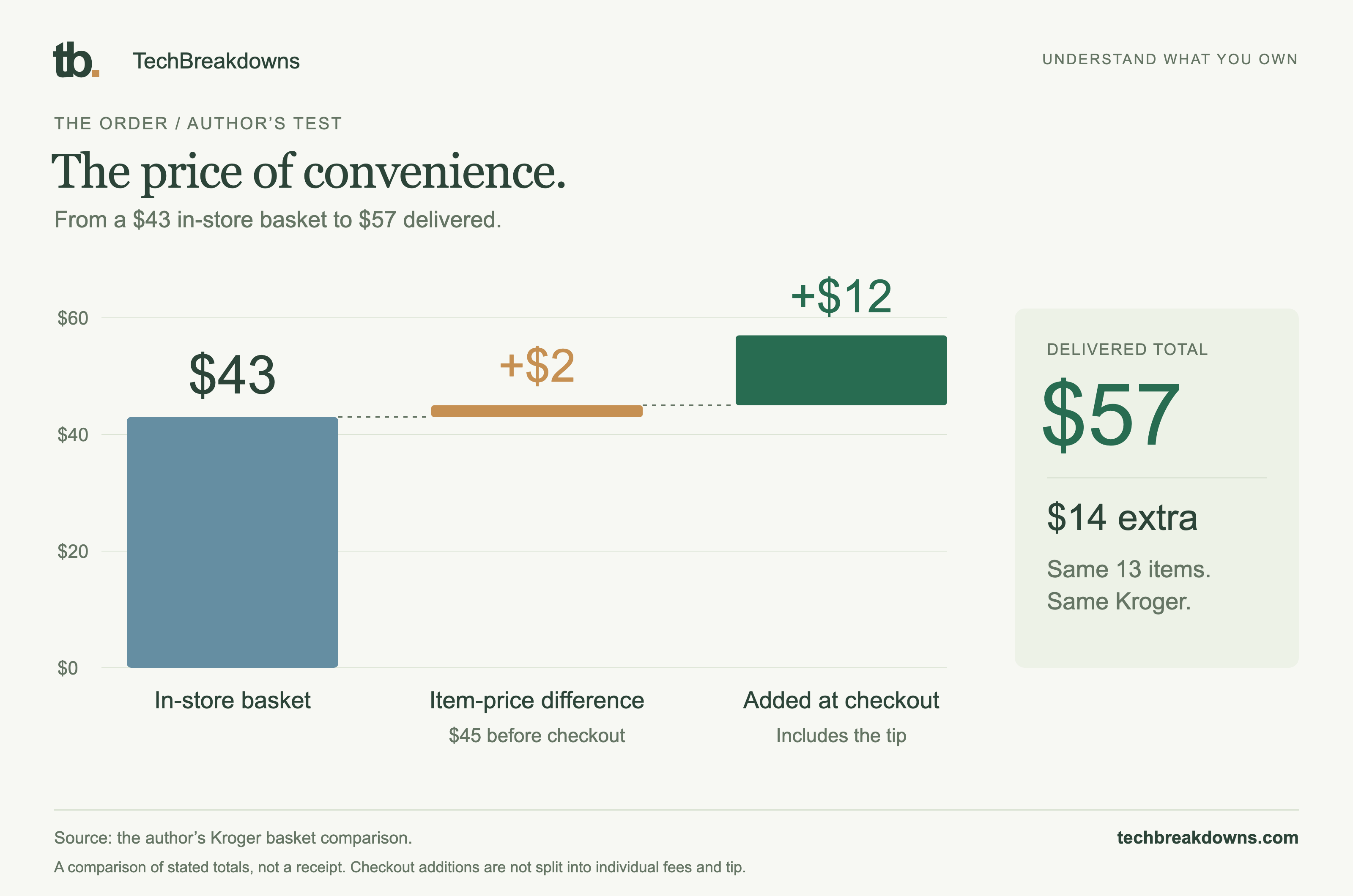
13 items, identical. All from Kroger. The in-store version? $43. The Instacart version? $45. By the time Instacart made it to my house? $57 (including a tip).
That’s a 32% expansion on my grocery budget for the convenience.
Of course, I saved two hours of my own time. No hunting for parking, making my way through crowded aisles, waiting for my turn at the checkout. That was all gone for $14.
Still, though, and this was my first experience ordering groceries for delivery, it did leave a sour taste in my mouth. If my 13-item snack run expands by $14, a normal weekly family shop of $150-200 with fees and a $30 tip on top soon starts to add up. It’s hard not to look at the receipt and feel nickel-and-dimed, especially when curbside carries zero markup and zero expectation of a tip.
But then a question arises... if grocery delivery feels expensive for consumers, punishing for the gig workers, and offers razor-thin margins to the already razor-thin retailers, how on earth does Instacart generate 74% gross margins? Well, that’s the story here: Instacart is not a grocery delivery company.
The Law of Transactional Gravity
I have a fundamental thesis on software: every successful consumer and enterprise software product will eventually become a payments and / or advertising company. Why? Well, because pure logistics and pure utility software are low-margin, commodity traps.
Uber builds a core marketplace and has a take rate. They still make a good chunk of money from instant pay transaction fees, the Uber Pro Card, and advertising.
We broke down Adobe a few weeks back. Believe it or not, Adobe has a commerce payment business.
Amazon? Yes. Amazon Pay, consumer credit & financing, “Just Walk Out” technology and an insanely large ad business. Apple and Google each have their own wallet and advertising offerings.
Instacart is no different. But why do these companies get there?
Payments (Flow of Money): When you’re facilitating millions, maybe even billions of transactions, you don’t just bill for software... you negotiate your way into interchange cuts, the card-issuing fees, float, and merchant settlement volume. There’s a ton of money here, and it’s enticing for anyone at scale.
Advertising (Capturing Intent): When a user is on your platform looking for something, and there are many options of that “something”—well, as a business with profit-making intent, you’re naturally going to gravitate towards selling that search intent to the highest bidder.
Delivery was never the finish line for Instacart; it was the Trojan horse. Fulfilling the order is the capital-intensive wedge required to digitize the shelves of 2,200 supermarket banners. Once they got the shelves digitized, Instacart was no longer just a gig-economy dispatch service. It instead became the OS of grocery retail, able to monetize search, payments, and collect a little fee off every grocery order it processes along the way.
It wasn’t all sunshine and rainbows to scale, though; Instacart has had to solve some engineering nightmares along the way.
The “Ghost Inventory” Engine
When you order on Amazon, the inventory is deterministic. A barcode was scanned when the goods rolled off the ship, scanned again at the warehouse, and scanned out when they put it in a box to ship to you.
If Amazon’s database says there are four units in stock, there are four units in stock. Grocery stores don’t live in that universe.
While technology has definitely improved at the larger retailers, there’s still a world between where your local Kroger and Amazon are at.
But let’s bring this back to Instacart. Instacart get their information from APIs where available, or, most of the time, via SFTP file drops that occur once a day, early in the morning.
That SFTP drop at 5AM might tell Instacart that the store has six bottles of oat milk. 8AM rolls around and three families have already grabbed cartons for breakfast. At 11:30, a carton is dropped on the ground and trashed. At 12:00, the remaining two bottles are added to an in-store shopper’s cart. They walk around the store for 20 minutes, change their mind and put them back with the butter.
If Instacart displayed deterministic inventory counts, every digital grocery order would be a disaster. Customers would be ordering items that vanished from the shelves hours ago. To survive, Instacart had to treat grocery shelves not as a database, but as a prediction problem.
Their solution? G-T-R. General, Trending, Real-Time availability architecture. Every product in every grocery store is assigned an availability probability from 0.0 to 1.0.
General: This is the long-term historical baseline. “How frequently is this specific item in stock over months of history?”
Trending: Bakeries tend to peak with fresh inventory at 7am. Butchers get a restock in the mid-morning. Dairy is generally gone on a Sunday afternoon. The model tries to keep track of all these trends at each banner.
Real-time: The tough one. With Instacart’s 600,000+ shoppers moving through the aisles in stores across the country, Instacart is able to take that data and apply it in real time.
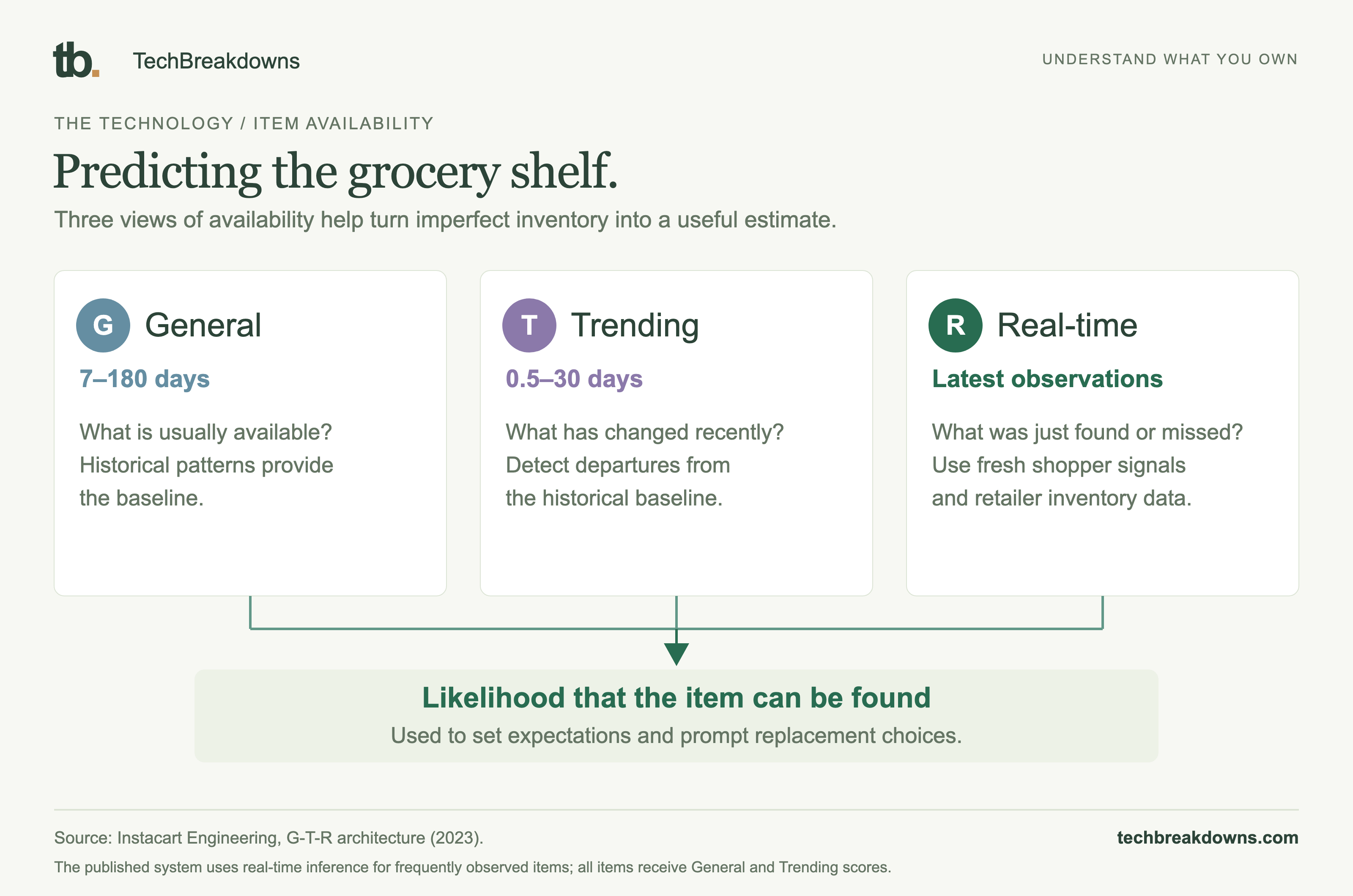
As mentioned, these three variables come together to make a score between 0.00 and 1.00. Instacart isn’t waiting around for a score of 0.00, though, before acting. Instead, the app uses a two-tower Siamese neural network to pre-calculate substitutions on the fly.
One of those towers processes the query item, while the other processes possible replacements using all the embeddings you’d expect:
Dietary taxonomy: If you’re buying gluten-free pasta... you probably don’t want a regular wheat pasta in its place.
Brand value: You might not be too happy to see generic-store beans at $0.89 replaced with the $4.25 gourmet artisanal beans.
Packaging: If the 16oz version is missing, are there two 8oz versions available within a reasonable price window?
Historical acceptance: How often, over millions of orders, do other customers accept the change?
By the time you reach the checkout screen, the app has already pre-ranked replacements for every item in your cart. On the riskiest availability scores, it has already asked you to confirm a replacement to make sure you end up a happy customer, and not resentful.
The Actual Shopping Is Tough Too
Instacart shoppers aren’t wandering the aisles hoping to find what you’ve picked; they are given a mathematically optimized traversal path to make things as efficient as possible.
And not just efficient: they need to make sure that your perishables don’t perish along the way.
First up are the heavy dry goods, then the delicate stuff; your dairy, meats, and ice cream go in last. Then it’s off to checkout.
When the shopper reaches the cash register, Instacart has to make sure they’re not sneaking in a free candy bar. To solve that problem, shoppers are issued a physical card provided by Marqeta that holds a balance of $0.00.
Instacart partners with Marqeta for just-in-time (JIT) payments. As the shopper unloads the cart, Instacart’s server is issuing API calls to Marqeta that fund the shopper’s card down to the exact cent required to fund the transaction. The authorization window then opens for a short time.
If the cashier swipes for $84.32 and the system calculated $84.32, all is good. If $12 of unapproved items sneak into the total, the card declines at the terminal.
Because Instacart is issuing these cards, they also capture revenue share on the card swipe volume flowing through the payment rails. Hey, I did say they’re a payments company, right?
Beyond the App: The Connected Store
In the introduction of this piece, I hinted that maybe Instacart isn’t for me. I don’t mind using it every once in a while, in a pinch, but I’m unlikely to become an Instacart+ member. I’m sure there are many like me, too.
The vast majority of grocery shopping still happens in stores, and that’s unlikely to change massively in the near term. If you’re a grocery delivery app, your total addressable market is capped at the 15% of consumers willing to pay a 30% premium for delivery.
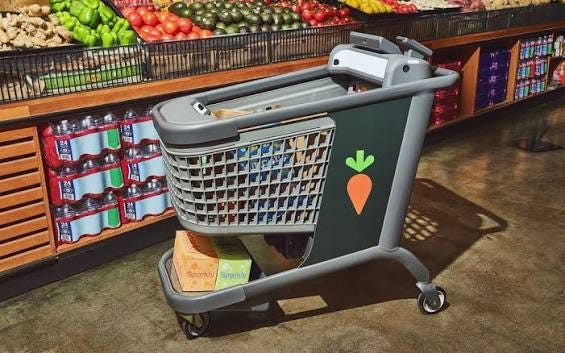
Instacart didn’t settle for that TAM; instead, they acquired Caper for $350M in 2021 to build the next level of grocery innovation with smart grocery carts.
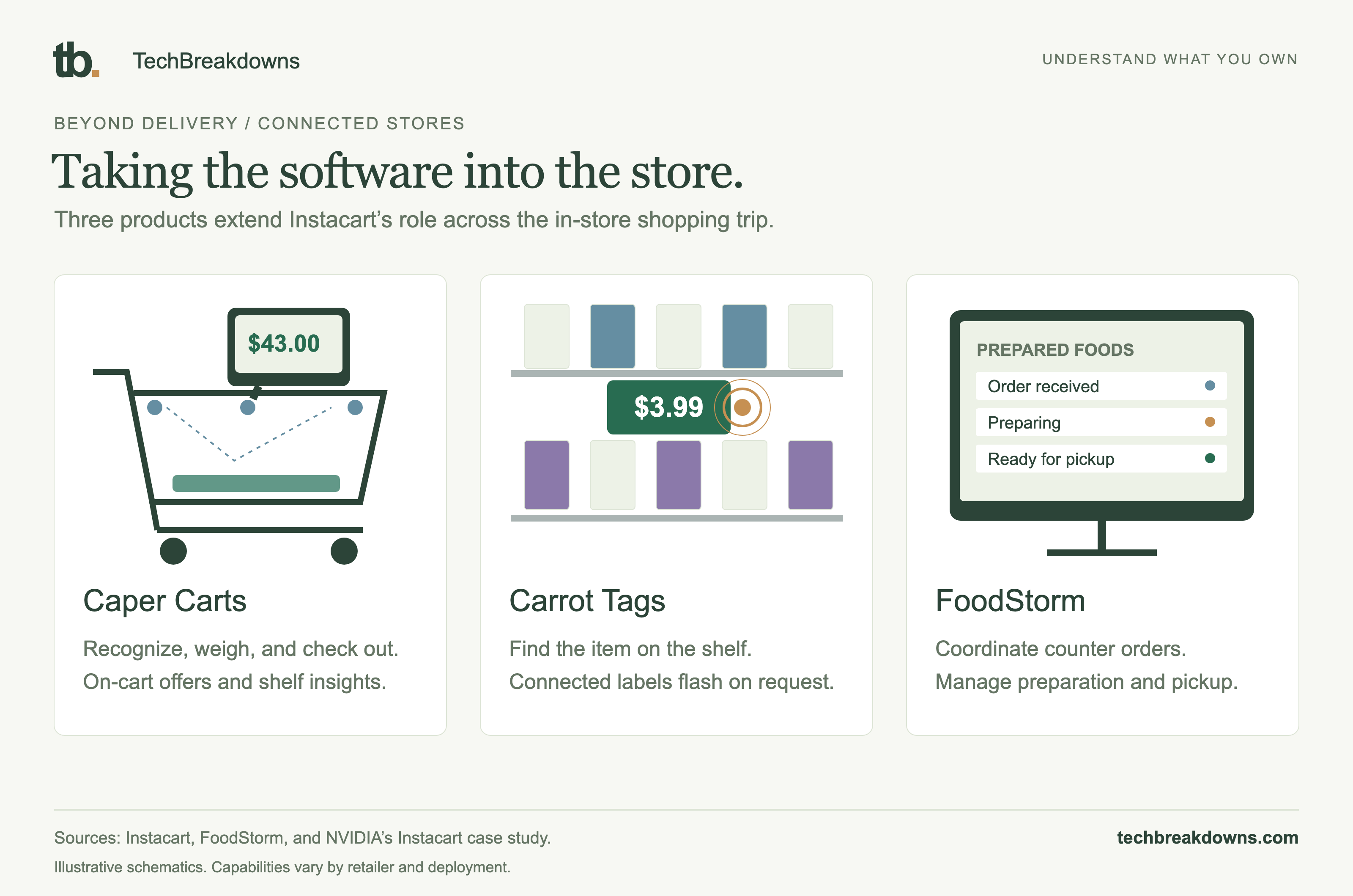
Caper Carts are edge devices on wheels. They look like your regular grocery cart, but they’re packed full of gadgets and gizmos:
Computer vision: A ring of high-resolution cameras surrounds the cart. When you drop in a box of cereal, the cameras scan the barcode without any extra effort.
Precision load cells: The basket is equipped with a high-precision electronic scale. When you place a bunch of bananas in the cart, it knows how much they weigh and can add the total right there to the screen. Drop something in there while obstructing the cameras and the cart knows, too.
Ads / gamification / reminders: It’s equipped with screens to show you offers on aisle six, provide gamified rewards, and even remind you to grab the milk as you’re heading to checkout.
GTR updates: Remember GTR from above? The outward-facing cameras can scan store shelves to feed right back into that inventory engine.
The carts are just one piece of the tech we’ve seen Instacart building out, too. Carrot Tags are another. Those electronic pricing tags you see stores adding allow app users to make them flash to identify where a product might be.
FoodStorm is a tool for managing the hot-food counter. When a customer orders a hot rotisserie chicken, FoodStorm helps time that chicken’s exit from the oven with the exact moment the shopper reaches the counter.
On the digital / app side, Instacart is integrating with ChatGPT and Gemini to build carts with ease. I tried Gemini’s implementation and it worked out pretty well. You can start with a recipe and then say “add that all to my Instacart.” Easy.
Clementine is Instacart’s foray into their own conversational agents directly in the app. It’s in beta right now. I wasn’t too impressed with my initial test runs but, again, beta. It does advertise functionality like “is there any gluten in my cart?” which I can see being a huge value-add to families that need to make sure they stay away from allergens.
The Moat
The peak of the story: what is Instacart’s actual moat?
In my research, bears view Instacart as a highly fragile courier app that is vulnerable to being undercut by Shipt, DoorDash, or even being squeezed out by its own retail partners.
I’d argue that this view misses the flywheel Instacart has spent the last decade locking into place. That flywheel connects four parties:
The consumers: locked into weekly replenishment routines, family favorites, and a historical order graph that makes the whole thing take minutes.
The grocers (2,200+): many of them have their POS system, electronic shelf labels, inventory drops and white-labeled mobile apps hardwired into Instacart’s enterprise APIs. Leaving would turn them from tech-forward to tech-backward overnight.
The shoppers (600,000 active): creating the local density required to make 90-minute deliveries feasible is not easy. Instacart owns the densest network in grocery.
CPG: PepsiCo, Kraft Heinz, and General Mills all pour tons of cash into advertising via Instacart because it’s able to move goods effectively and efficiently.
Delivery fees cover the costs of running the real-world business. Advertising comes in as pure software profit with gross margins north of 70%. Instacart is also moving Carrot Ads off-platform, so their cash cow has the potential to get even bigger.
The moat, then? Instacart is the indispensable neutral operating system of modern grocery.
Where It Cracks
Everything has a breaking point, and Instacart is no different. While I tend to take a more optimistic view in my breakdowns, I always like to consider the pessimistic side of things, too.
Here are the four areas where I see a potential breaking point for Instacart:
The 30% wallet expansion: delivery is a luxury experience. It’s hard for households to justify paying 20-30% more for their weekly staples.
Tipping culture fatigue: the psychological drag of gig tipping creates friction that subscription pricing has yet to solve. Sleuthing Reddit shows that there are plenty of consumers leaning towards pickup just to bypass tipping awkwardness and delivery surcharges.
Retailer concentration: while there are 2,200+ banners on the platform, [the top 3 account for 43% of gross transaction value (GTV). It’s the smaller guys that need Instacart; the bigger ones could one day bully them around.
Regulatory scrutiny: Instacart has been in trouble with the FTC before and paid a $60M settlement for delivery fee representations and subscription disclosures... and this could erode customer trust.
Does the Stock Work?
The engineering works, the operations are impressive, and the hardware they’re building is genuinely cool. But... will the stock make you money?
The remainder of this post is for our premium subscribers.
In our premium deep-dive analysis of Instacart, we leave the qualitative story behind and open the quantitative financial hood:
The SBC & Owner-Cash Scalpel: Reconciling reported Free Cash Flow against equity dilution to calculate real, unvarnished Owner Earnings.
The 5-Year Model: What growth rate and ad take rate does today’s stock price actually imply?
Bear / Base / Bull Scenarios: Sensitivity tables modeling downside floors, base-case compounding, and upside optionality from Caper Cart rollouts.
The Final TechFolio Verdict: Our official sleeve classification, risk-reward rating, and model portfolio allocation decision.