
It’s Amazon’s World; We’re Just Here To Buy It
How Amazon turns every cost center into a business, and what's coming next.


Amazon is a fun company. If you asked anyone what Amazon does, they would likely say it is an online store. If you asked anyone in tech what Amazon does, you might get that they run AWS. The true story is that they do literally everything.
Today, on May 4, Amazon announced that they are allowing others to use their logistics business. They are opening their entire logistics network for freight, distribution, fulfillment, and parcel shipping services to every business of all types and sizes. It does not matter if you are 3M and you are shipping Post-it notes, or if you are Procter & Gamble and you are trying to ship diapers. You can do it around the world now on Amazon’s Supply Chain Services.
Amazon does this a lot, and they have been doing it for a long while. In 2015, Social Capital put out a slide deck, and in that slide deck it said that Amazon turns every major cost into a source of revenue.
It got me thinking. What else is left for Amazon to do? Where else are they missing?
First, The Wedge
Amazon did not just jump straight into supply chain services. They have been slowly building these capabilities for years.
You have no doubt seen Amazon’s delivery vehicles on the streets you live on. That was one phase of this game plan. They needed to figure out last mile delivery, and they have been running last mile delivery for some other services for quite a while now.
More recently, Amazon needed to figure out how to move their goods around at the middle of the network, not just from a warehouse to a doorstep but from one distribution center to another, or from a partner’s distribution center to theirs. The answer there was a product called Relay. Relay is a truck board where Amazon posts loads that need to be transferred between distribution centers, and truck drivers or box truck owners pick those loads up and get paid as contractors.
That was another part of the wedge. Amazon does this persistently. They find their own needs, they iterate, and they push each piece a little further until it becomes a full-blown product like Supply Chain Services.
What is great about the way Amazon does this is that they are doing it with things they actually use. They needed last mile delivery. They needed truck drivers to move stuff between distribution centers. They needed planes to move stuff across the country. They build these things for themselves first, run them at Amazon scale, and then turn them into a product everyone else can buy.
A Quick History of Amazon Eating Its Own Costs
Just in case you are not familiar, this is a thing that Amazon does quite frequently. It is a predictable pattern, not just a one off.
It started with AWS in 2006, and Amazon Web Services now dominates the internet. Google Cloud Platform and Azure are still trying to catch up.
In the 2010s, Amazon entered the advertising game, allowing people to buy advertisements.
There was then Fulfillment by Amazon, where if you were a small time retailer, you could send all your products to Amazon. Every time somebody hit purchase on Amazon.com, Amazon would box that thing up and ship it off for you.
There is Amazon Lending, there is Buy with Prime, and there was Just Walk Out, the cashierless checkout technology that started in Amazon Go and has since been licensed out to over 180 third party stores including stadiums, airports, and college campuses.
AWS Ground Station launched in 2018, letting any satellite operator rent ground station time by the minute. Amazon built this for their own satellite ambitions, including Project Kuiper, their internet service provider that competes with Starlink. Companies like Capella and BlackSky now use it too.
This is not just a one off. This is Amazon in a nutshell.
So, What Got Hit?
The obvious names are UPS and FedEx. Both of these companies sold off massively on the news of Amazon launching its Supply Chain Services. Both stocks closed down roughly 10 percent on Monday.
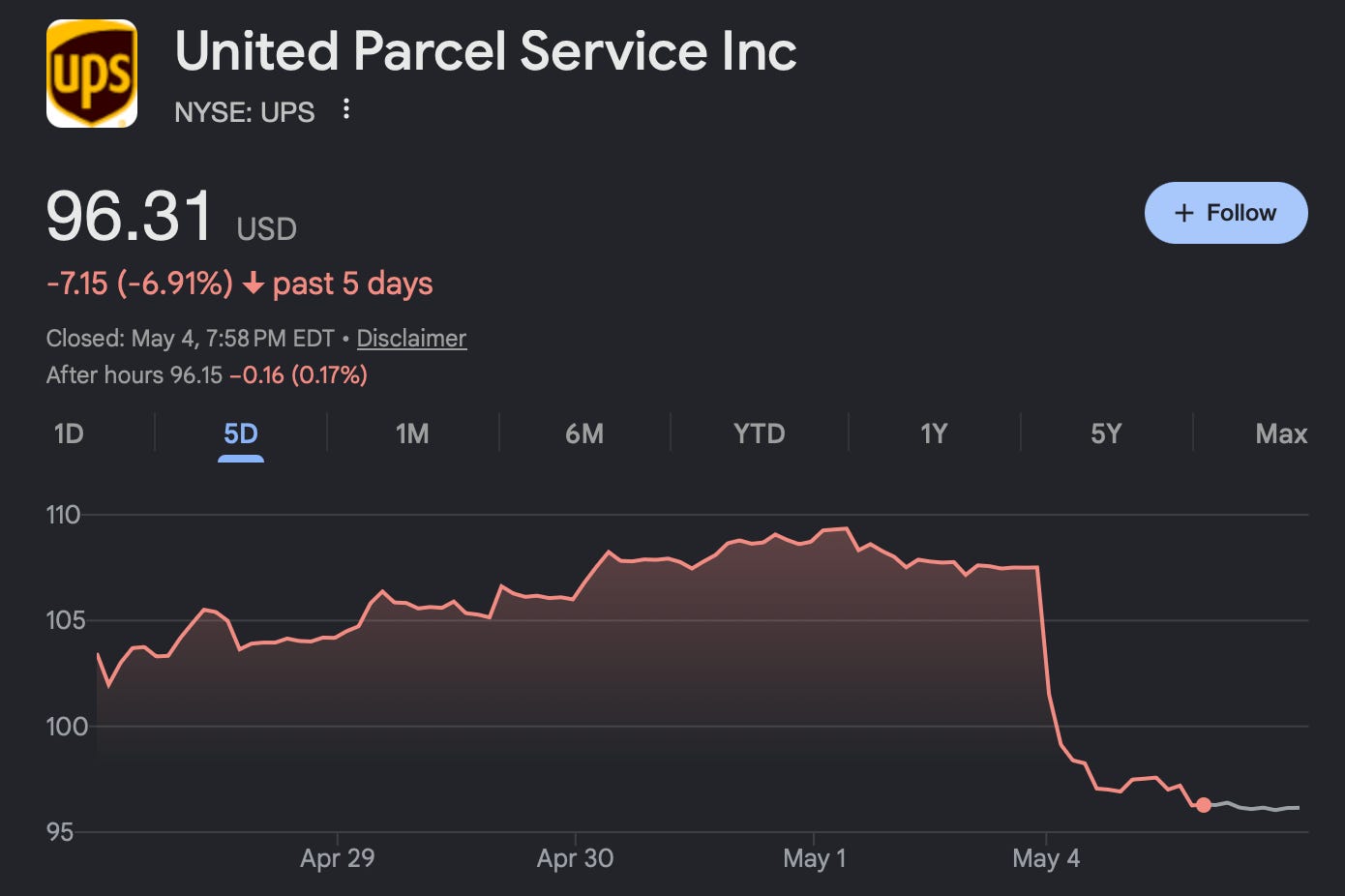
This is a tech publication, so I am not here to comment on the merits of UPS and FedEx, but I imagine that those companies do have some contracts that Amazon will probably steer clear from, at least in the near term. These include things like being embedded in healthcare, defense, B2B contract logistics, and probably some other moats around areas like residential parcel delivery that Amazon cannot easily get to.
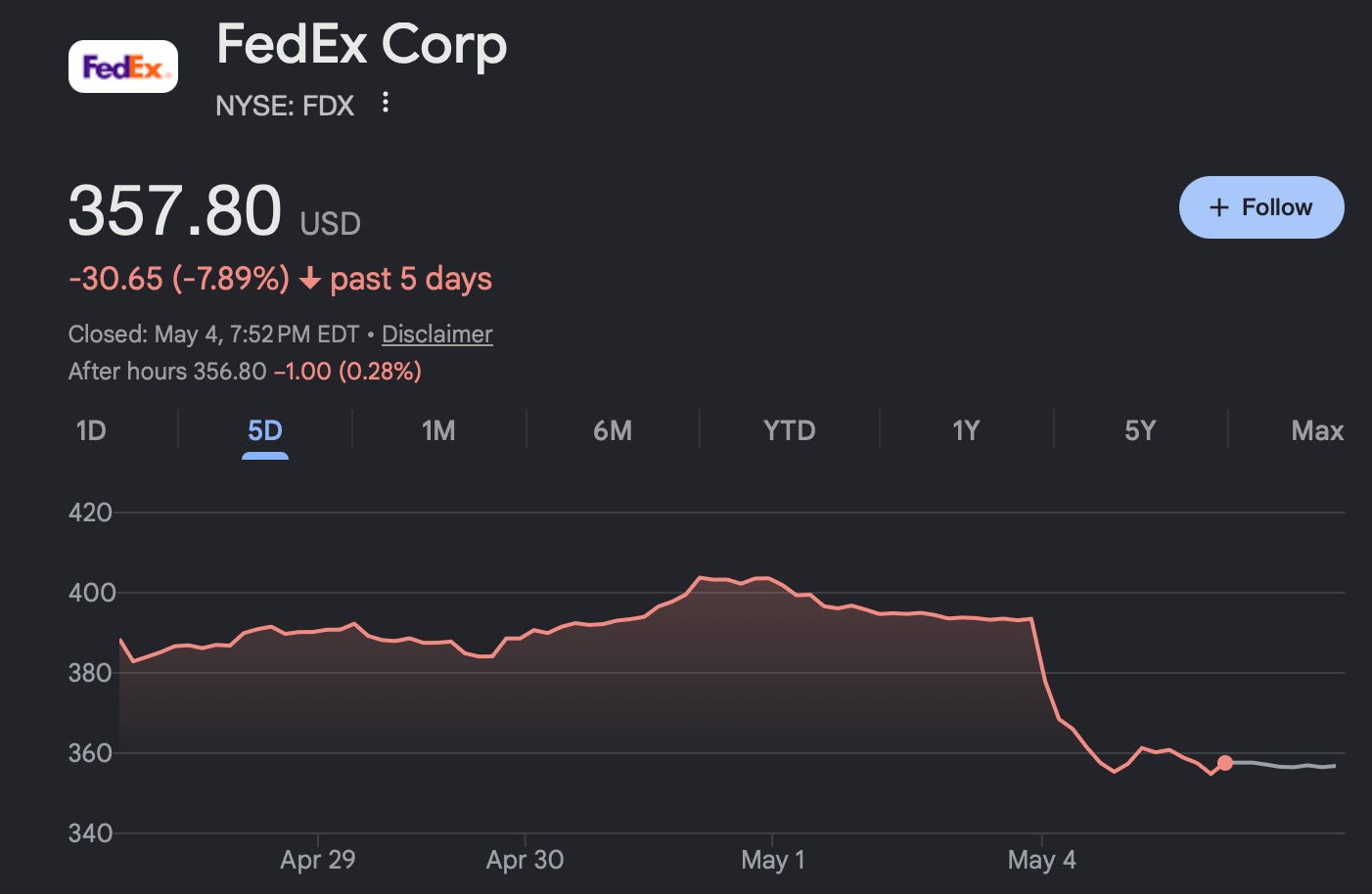
But that was the headline trade, right? Let’s look a little bit deeper. What are some other companies that might have some difficulties?
A more interesting exposure is in the middle of the supply chain, where the substitution starts to become a little bit more direct. You have freight brokers like C.H. Robinson, XPO, and Hub Group that exist to match shippers with truck capacity. Amazon has been quietly building that with Relay, and ASCS now formalizes that offering.
If you are Procter & Gamble and you can move freight on Amazon’s network with Amazon’s pricing and Amazon’s tracking, and then you can also very quickly put most of that stuff on Fulfillment by Amazon, your reason for using a broker shrinks. Brokers run on the margins and they have very little structural protection from something like this if it were to scale significantly.
The worst off will be third party logistics providers, the 3PLs of the world. These are companies like GXO. Worth noting that GXO actually fell more than UPS or FedEx on the announcement, dropping more than 13 percent on Monday. These companies operate warehouses and run fulfillment for major brands. We have named Procter & Gamble a few times. That company was named in Amazon’s launch letter. But also names like 3M, Lands’ End, and American Eagle. They are not just going to start shipping with Amazon; they are warehousing with Amazon. That starts to really eat into some of these 3PL relationships.
Shopify is another name worth looking at. Shopify did try to build its own logistics business but ultimately ended up selling it to Flexport in 2023 for a 13 percent equity stake in Flexport. Flexport has been integrated with Shopify ever since, helping it out in this domain.
Shopify merchants now have a cleaner path to using Amazon for their entire backend fulfillment solutions while keeping their storefront on Shopify. Maybe the next logical step for Amazon might be to allow for better branded storefronts, thus eating Shopify’s lunch.
That one is a bit of a stretch, but you have got to throw it out there.
A thing worth pointing out to close this section off is that the market tends to overprice the immediate damage to companies like C.H. Robinson or FedEx immediately after megacorps like Amazon announce something. However, that damage is not immediate. It tends to happen over 6 to 18 months.
What’s Left?
I started the article by asking: what is left? Amazon seems to have turned everything it does into a product. Is there anything left for Amazon to still sell?
I dug in, and the answer is absolutely yes.
Energy procurement is one of the big things. Amazon is the largest corporate buyer of renewable energy on the planet, and has been for years. They have built sophisticated PPA structuring and grid procurement capabilities. Could they do this as a service for others? Could this be the AWS for energy? It definitely could be. It tends to be along the lines of the capability that they would externalize if they could.
The more logical path right out the gate is tax, trade, and customs compliance. Amazon handles international VAT, customs classification, and cross border trade at a scale that nobody else operates at. Most of this is currently embedded inside Seller Central, but the capability could easily be unbundled into a service that could be used by any importer. The market for this is fragmented and full of legacy software vendors, and it is a classic Amazon target that is along the lines of what they announced today.
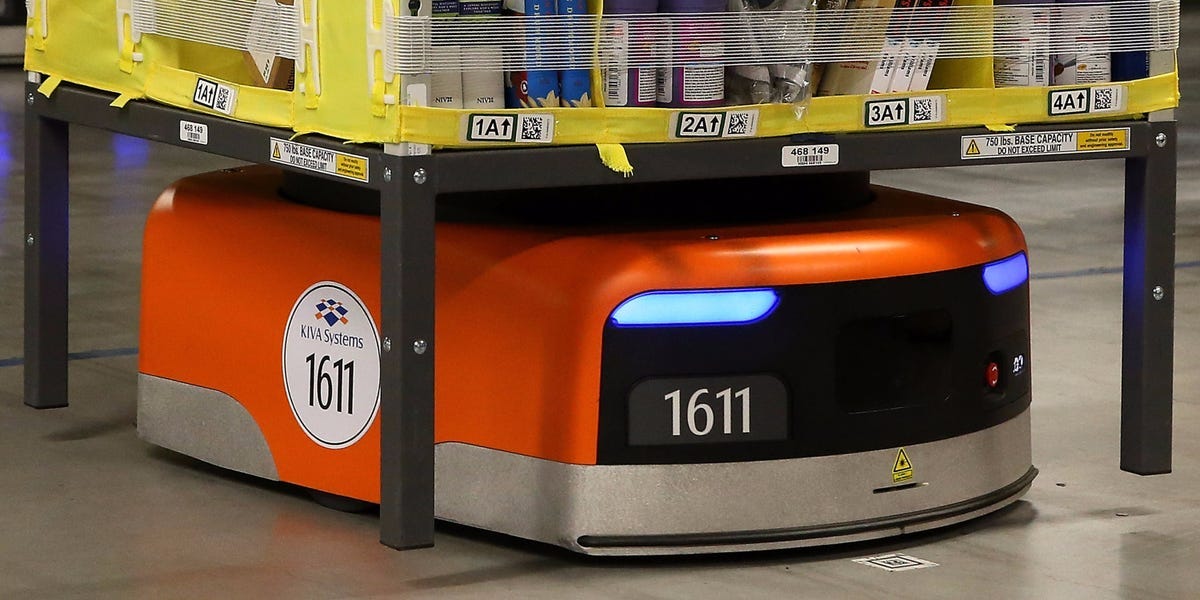
Back to the wild side, we have robotics fleet orchestration. Amazon Robotics runs the largest mobile robot fleet in the world inside their fulfillment centers. The orchestration software, fleet management, and simulation environments are all mature. This would compete with businesses like Symbotic if they were able to bring it to market. Symbotic has one big customer in Walmart, so it is probably not going to take away that customer, but it could affect future sales for a company like Symbotic.
The Trade
Every time Amazon externalizes a capability, they are not just creating a new revenue line; they are restructuring an entire industry around themselves.
AWS did not just compete with enterprise IT vendors; it changed what enterprise IT even means. Most companies no longer run their own infrastructure because Amazon made it irrational to.
Amazon FBA changed what it means to be a small retailer. Now you can get started really cheap and easily. You no longer need to go to a 3PL for quite some time unless you are doing something very specific that requires a little more handholding than you can get from Amazon.
Supply Chain Services is the same kind of shift in a different vertical. Procter & Gamble is not going to keep its existing logistics relationships and add Amazon on top. They are going to gradually consolidate spend towards whoever offers the best price, the best tracking, and the most reliable network.
Guess who has all 3 of those? It is Amazon, because they built it for themselves first. The whole logistics industry is about to get reorganized around Amazon as the default backbone, the same way that enterprise IT got reorganized around AWS.
Amazon used to be just a retailer. Many still know it as a retailer, but it is so much more than that now. It is the infrastructure that other companies build their livelihoods on.
AWS is the compute layer of the internet. FBA is the fulfillment layer of e-commerce. Ads is the discovery layer of commerce. Supply Chain Services is going to become the logistics layer of physical goods. Each of these is a layer that sits underneath whatever other businesses are doing, and each of them was originally built to serve Amazon itself.
And that is why it is a pattern that is so hard to fight. Incumbents in any of these industries are not competing with just another company. FedEx is not competing against another UPS. C.H. Robinson is not just competing against another XPO. They are instead competing with infrastructure that has been pressure tested at a scale that they themselves can never reach.
Our job as investors is to try and figure out what industry is next. I believe it will be robotics. Amazon already runs the largest mobile robot fleet in the world inside their own facilities, they have been deploying Agility Robotics’ Digit humanoid in their warehouses since 2023, and they acquired the Belgian robotics firm Cloostermans in 2022. The internal capability is being scaled up aggressively, and that is exactly the pattern we saw with AWS in the years leading up to 2006.
The most exposed name, as we already mentioned, is Symbotic (SYM) and a London listed company Ocado (OCDO). If Amazon were to announce robotics, you can bet that these companies would plummet overnight.
Symbotic was a name I was already looking into for a TechBreakdowns deep dive, but I ended up stopping because of the Walmart concentration. If I were invested in Symbotic now, I would be worried just knowing that Amazon is going to keep collecting these puzzle pieces. Because yes, this is Amazon’s world and we are just here to buy it.