

MercadoLibre is a name I’ve gone back and forth on for years. I’ve held it in the hundreds, I’ve had it in the portfolio in the 2,000s as well.
We’re here, though, to craft a portfolio of tech that helps us sleep soundly at night while offering the potential for outsized growth. One of the first names that came to mind, and the first company we’ll be breaking down is MercadoLibre (MELI).
MELI meets the quantitative criteria for a Reinvestor. We found that if we can get ourselves buying the top half of the Reinvestor cohort, we could be onto 30%+ gains per year. So, here’s the first swing!
The Rails No One Would Build
It’s a name most Americans don’t know. A quick search would very quickly lead you down a path of learning it’s “the Amazon of Latin America.” But, just like Amazon, the company isn’t stopping at being an e-commerce platform.
Before we get to all that fancy stuff though, let’s dive into that comparison with Amazon a little more. Amazon is a fantastic company, I’m not going to doubt that even one bit (I’ve been a small holder since 2009, and it’s grown massively).
Amazon though had some benefits in getting started. It was plugged into a country that already had FedEx, UPS, Visa, and a banked population. MercadoLibre started in a continent that had none of that, so MELI built it itself.
There was no logistics network to deliver goods, MELI built one. There were no payment rails for the largely unbanked, MELI built them (and now is its own bank). Along the way it survived the dot-com bust that wiped out the vast majority of its Latin American peers, it turned eBay from a rival into a shareholder that later cashed out, it held Amazon off at number two, and it kept growing through Argentina’s currency crises and triple-digit inflation. It has been a 100-bagger since its 2007 IPO.
MELI Today

Today, the company operates in 18 countries offering various parts of its massive ecosystem in each one. That ecosystem is made up of three main businesses: E-Commerce, Acquiring, and Fintech Services.

The company is LatAm’s E-Commerce leader, continuing to grow at a significant clip and showing no real signs of slowing down.
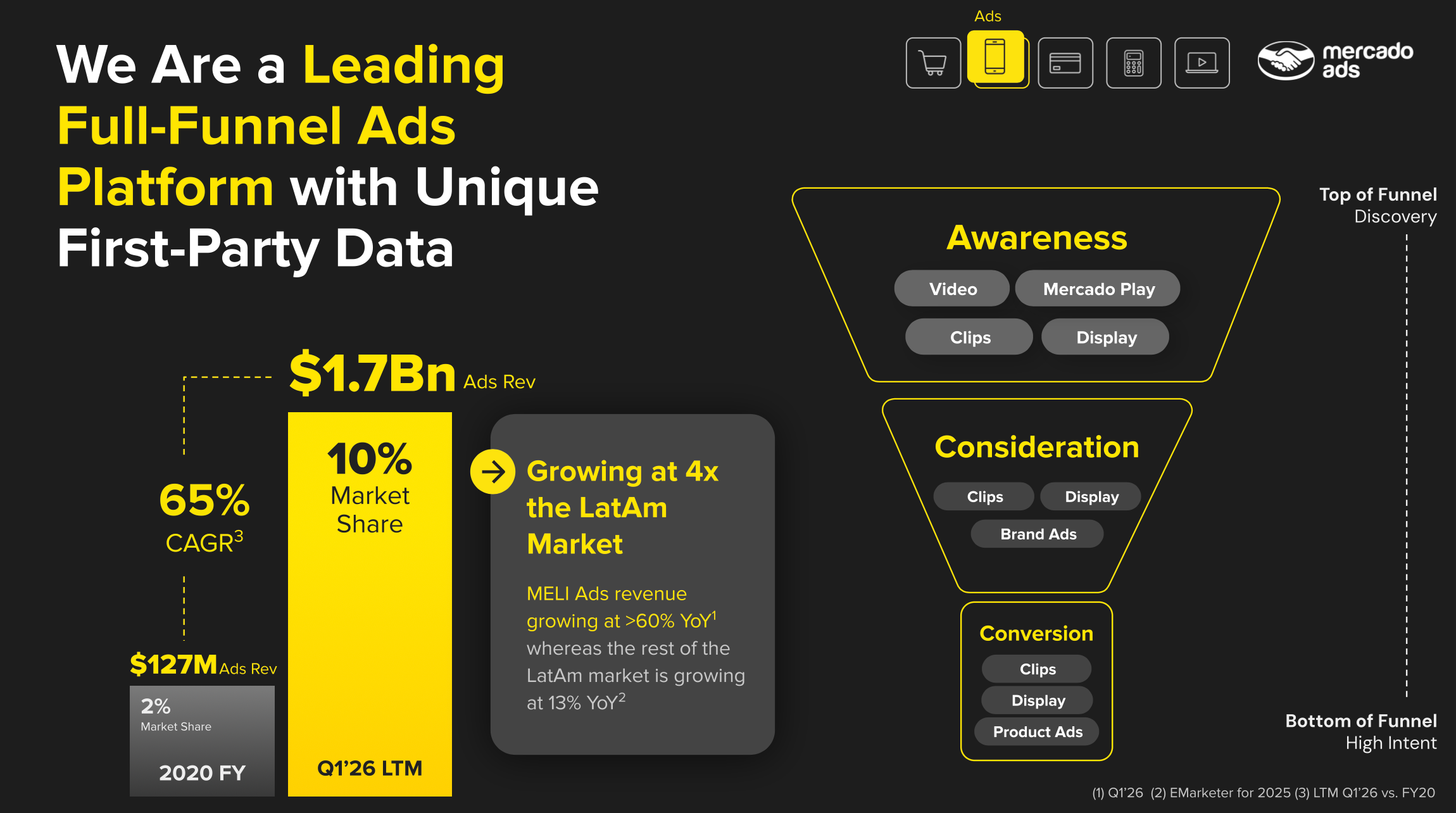
MELI’s ad business is growing at 73% year-over-year, and digital is still only about half of Latin America’s ad spending versus three-quarters in the US.
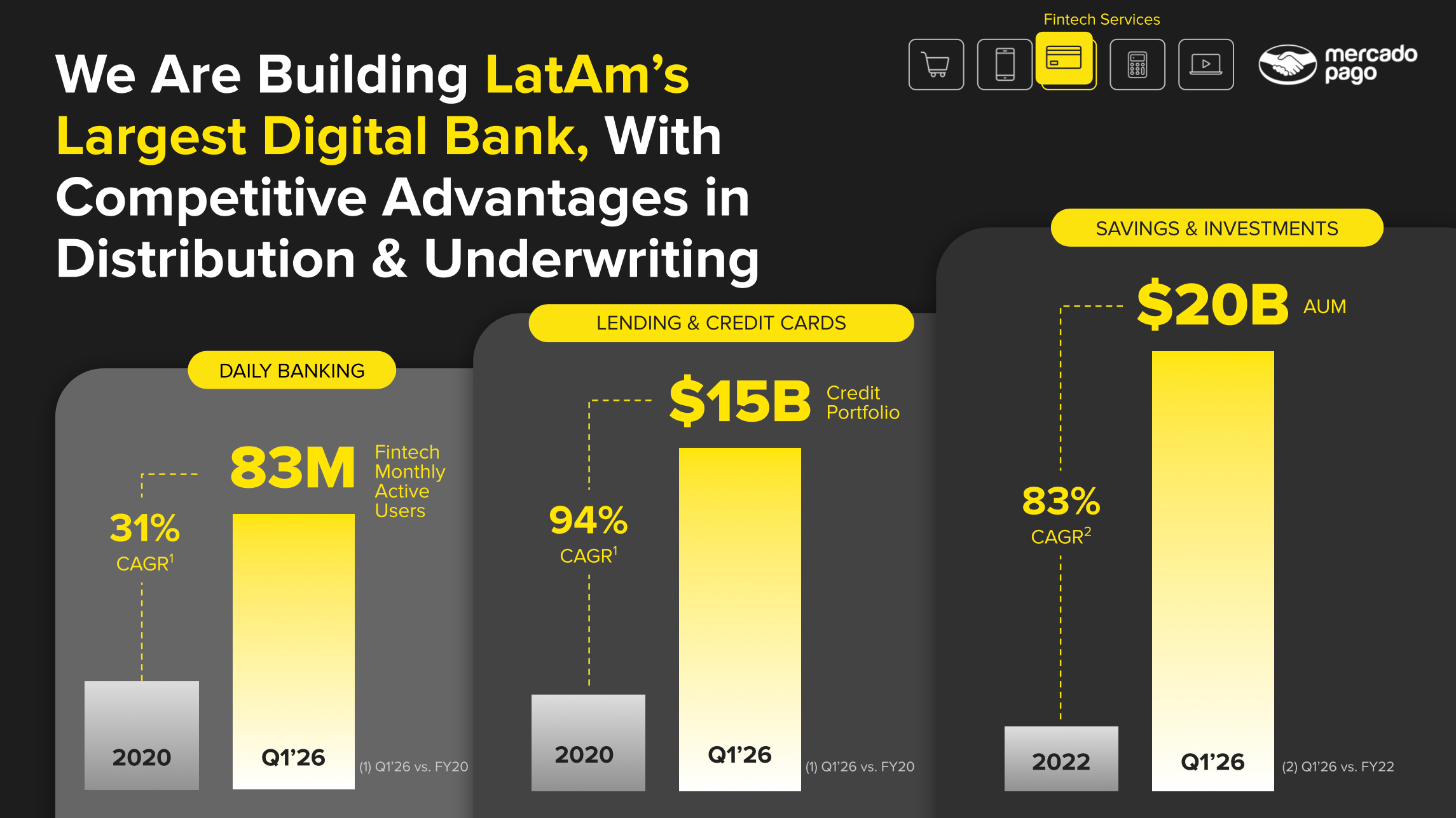
And they’re building a massive bank as a sort of side gig. 83 million monthly active users. $14.6B credit portfolio from lending and $20B of savings and investments through the platform.
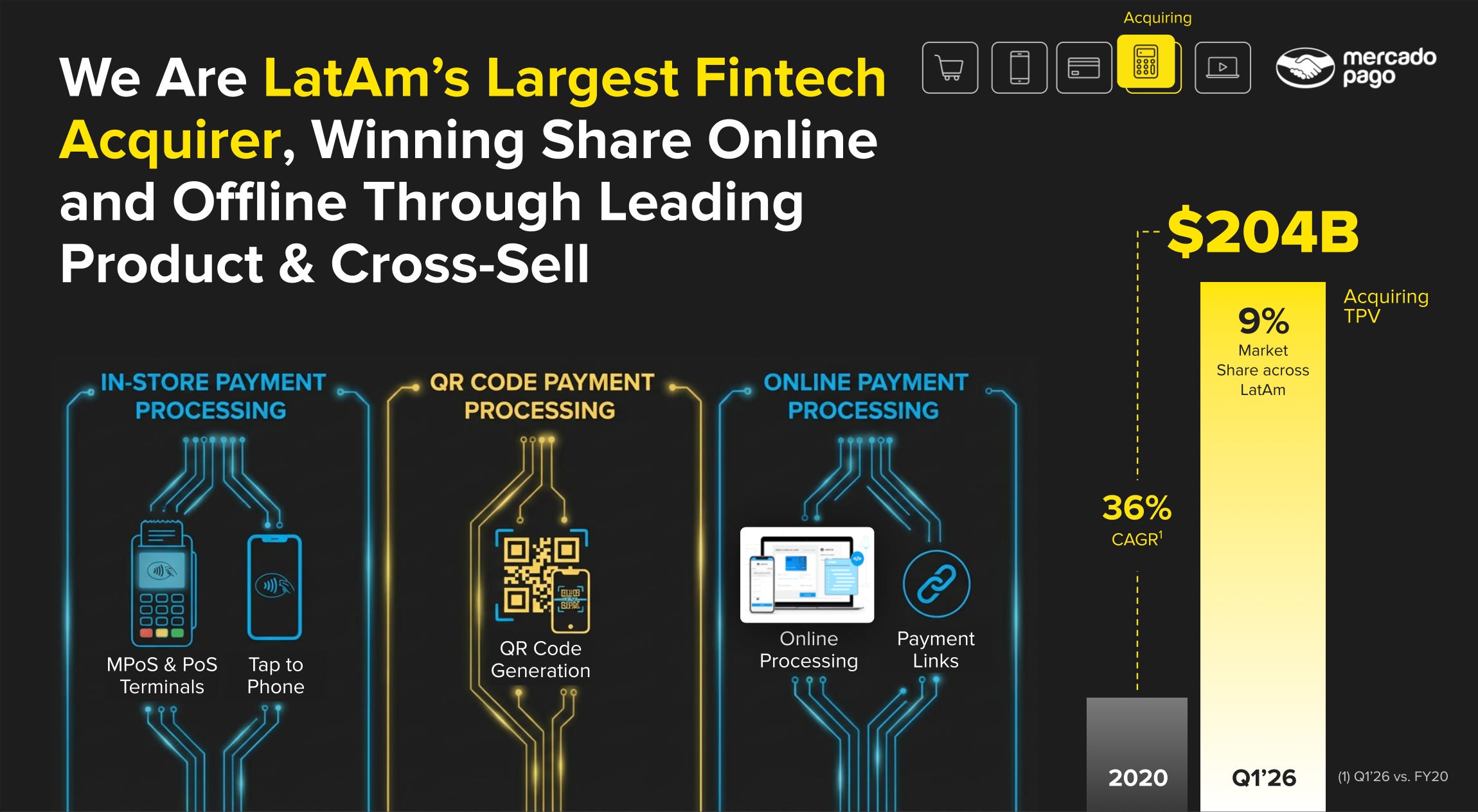
Oh! And they’re one of the largest acquirers in the continent. While not quite South America, I did recently go to Mexico and every payment terminal I encountered had the company’s Pago logo displayed. Taxis, vendors, restaurants. MercadoPago has done a fantastic job at getting their solutions into the wild.
The vast ecosystem is the company’s competitive advantage. Merchants can use payment systems, take loans, bank with Mercado, and even ship what they’re selling via the logistics network.
The Founder Who Chooses to Invest
Marcos Galperin is the cofounder and former CEO of MercadoLibre. The stories above? He’s the one that made them happen.
He wrote the business plan for MELI in a class at Stanford in the late 90s, after studying eBay of all things. As the story goes, a professor asked him to drive a visiting investor to the airport, a private equity guy named John Muse. Galperin pitched him the whole way there, and Muse wrote one of the first checks. He pulled in a few classmates, Hernán Kazah among them, and they went and built it. That was 1999. Galperin ran the thing for the next 26 years.
On January 1, 2026 Galperin stepped down as CEO, handing the reins to Ariel Szarfsztejn, the insider who had been running MELI’s commerce business. Galperin remains with the business as its Executive Chairman, which in founder terms usually means he kept the one job that matters to us: deciding where the money goes.
And that’s the whole reason MELI shows up on our Reinvestor list. Given the choice between showing Wall Street a fat profit today, or feeding that money back into the machine to make the business harder to kill tomorrow, Galperin picks the second option every single time.
He did it with logistics. For years MELI ran its own shipping network at a loss while everyone waited to see if it would ever pay off. He did it again in 2016 with free shipping, ate the hit to margins, and let it compound into a moat. And he’s doing it right now with the credit business. That one we’ll get to in a minute, because it’s the whole reason the stock is down, and the whole reason it’s interesting.
The Number to Watch
If MELI stock is as good as it looks, why has the stock been on such a roller coaster and down ~20% over the last year?
Well, we can sum it up with one number, and a number any buyer of MELI should be paying close attention to when earnings are released on August 5th: operating margins.
Last year, MELI was keeping about 13 cents for every dollar it took in. Last quarter it was down to 7 cents. Wall Street has seen margins cut in half, and it did what Wall Street does: it sold.
Did margins collapse because customers are leaving? Did they collapse because a competitor is undercutting them? Nope. Nobody undercut them. Nobody left. The business didn’t get weaker.
The margin fell because Galperin spent it. When a loan gets booked, so does the expected loss the moment that loan is written, even before it earns a single cent back. So, when your loan book nearly doubles in a year, that up-front charge explodes and eats today’s margin. There was also some big spending on shipping and marketing to defend their Brazilian territory.
So, the margin hasn’t broken. It is being reinvested.
A Risk To Watch
Those operating margins will be something to watch on August 5th, but another thing is going to be that credit book as a whole. That same credit book that’s ballooning and eating margins could be a burden on the company as a whole.
It’s a $14.6B pile of consumer loans, in Latin America, growing at 87% per year. Sure, MELI has already reserved for its bad loans, but those are only management’s presumed losses. If we see signs of early delinquencies rising, things might not look too rosy on the other side of earnings.
So that, to me, is likely the biggest risk the company faces near term. It’s a fantastically built business with lots of arms, and lots of “outs.” But the future of the business is being staked on fintech, and it’s an arm of the business that has seen solid growth.
Verdict
Our paid subscribers get to go a little deeper, but I do just want to call out here for all readers my thoughts. I believe that MercadoLibre is a fantastic business offering investors diversification away from U.S. tech.
Still sitting within the leadership structure is Marcos Galperin who has proven to be an elite-level capital allocator over the last nearly three decades of this company’s existence.
That said. This wonderful business is not just a buy-it-and-forget-it. It’s one that you keep your eye on, particularly the loan book.