

One of the phases of my research into a company always involves listening to a couple of podcasts. I like interviews, I love origin stories, and I’ll settle for a breakdown of the biz.
In the case of Nu, and the reason I’m opening this breakdown like this, I listened to one of the best and most engaging stories of a founding I’ve ever come across with the Crucible Moments episode featuring Founder & CEO David Vélez. I’d recommend anyone reading this also listen to the episode (hey, your dog would love the walk too).

This, at the time of writing, $70B company is a bank. It generally wouldn’t show up on a tech website, but here we are. I think it’s fair that it shows up here given that Sequoia were an early investor, and given the tech-forward nature of what we’re looking at.
Nu, though, is a bank. It’s a bank that started in Brazil and has since expanded to Mexico and Colombia in the hopes of running the same playbook, and that playbook appears to be working.
So why are we here? Nu is not your standard bank. It’s actually an AWS-native software platform with a $1 cost to serve that happens to hold a banking license. Let’s dig in.
The Revolving Door
In the podcast I linked above, Vélez tells the story of trying to open a bank account in São Paulo back in 2012. He had just moved to the country for Sequoia, but they ended up shutting down their LatAm office almost immediately due to a lack of investment opportunities. He was there, in a new country, without a job.
I’ve never banked in Brazil, but it sounded like a nightmare. You didn’t just walk in and make your way to the teller, you had to pass through bulletproof glass, metal detectors, the works. If you set off those metal detectors while inside that bulletproof glass, you were locked in while the situation was figured out.
Once Vélez made it inside the bank it took him six trips over four months and stacks of notarized paper to get an account approved. And the reward at the end? $30 in monthly fees for his bank account and a credit card charging 300% interest.
At the time, Brazil was run by a five-bank cartel. Itau, Bradesco, Santander, Banco do Brasil, and Caixa. Between them, they controlled around 80% of all the banking assets in the country and made 20%+ ROE every year while providing what sounds like the worst service on Earth. They got away with it because customers had nowhere else to go.
Anyway, the story ends up coming full circle. Fresh off the nightmare of opening a bank account, Vélez decided to start a bank with no branches, all run by an app. A tech forward bank. He was laughed out of many rooms, but Doug Leone of Sequoia wrote the seed check.
There’s a lot more to the story, but we’re trying to be efficient with words here. The bank and its credit card did eventually become a reality. A purple card entered the Brazilian market on April 1, 2014. It wasn’t a hit out the gate, but once it caught its stride it ended up taking the market by storm.
The $1 Cost to Serve
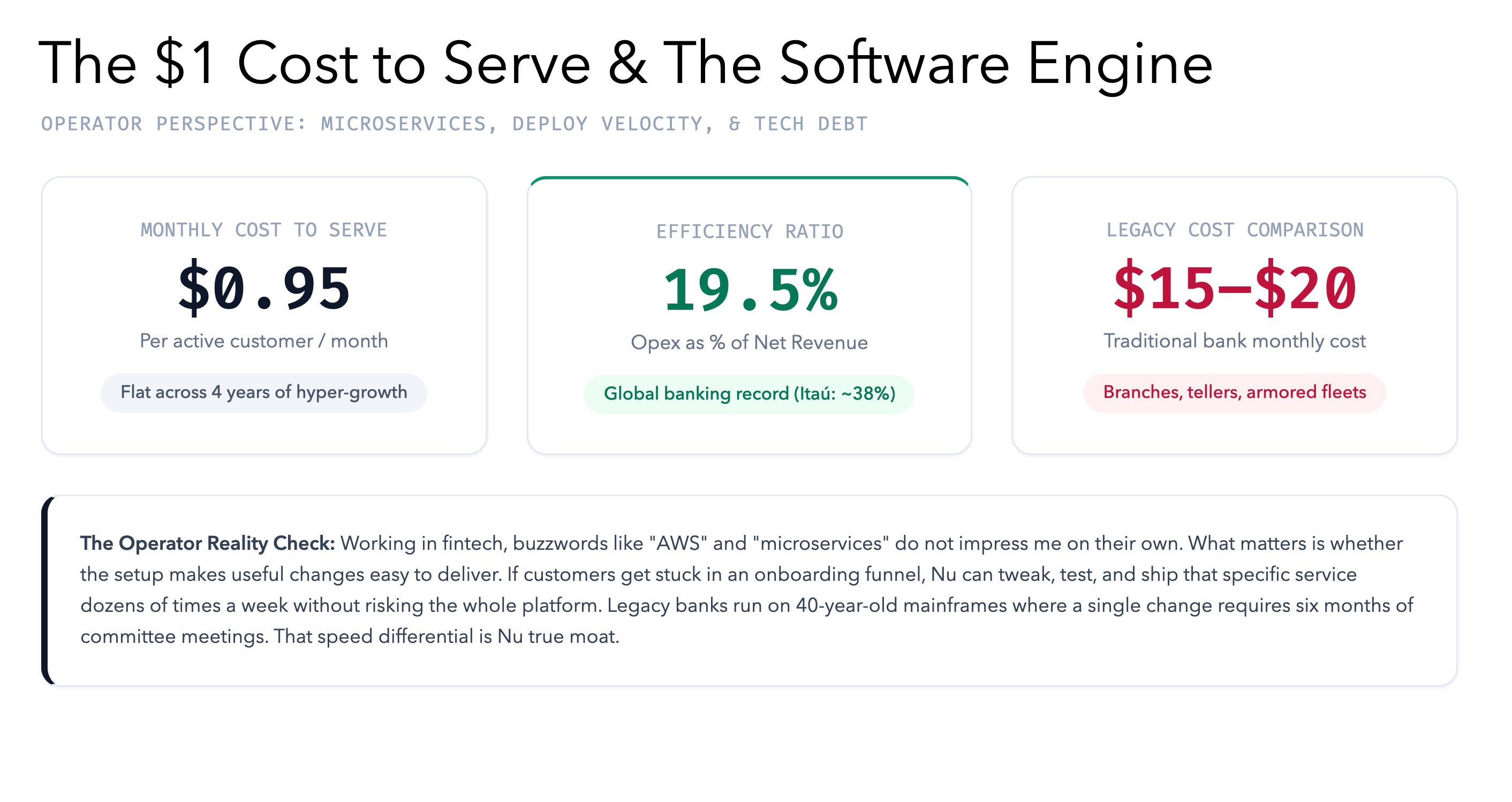
The thing that really sets Nu apart is the $1 monthly cost to serve. I’ve worked in fintech. Trust me, that’s low.
The obvious savings come from lack of branches. Nu doesn’t have to carry all that baggage. But the tech question is more interesting than simply moving banking to an app.
I work in fintech, so I’m not automatically impressed by the words “AWS” and “microservices.” What interests me is whether the setup makes useful changes easy to deliver and the business cheaper to operate.
For example, let’s assume customers keep getting stuck partway through an application. Most would give up, some would call support to get it finished.
The useful promise of splitting software into smaller, independently changeable services is that a team can improve that part of the experience without having to change the entire banking platform at the same time. Of course you’ve still got to test and deal with controls... smaller pieces don’t mean fewer problems in all cases.
But suppose the team can test a simpler application. They can see where people get stuck, fix, test, iterate, and improve again.
Once they get to a place where more people finish the application, they’ve built a winning process. The structure that Nu has allows them to get to that winning process much quicker than at a legacy bank.
That’s what I’m looking for at Nu. Not more software releases for their own sake, but evidence that the company can improve the product while keeping the work required to serve each customer under control.
The architecture is a possible enabler of that advantage. It isn’t proof of it. A low cost-to-serve figure tells us something about the outcome; it doesn’t, on its own, tell us how much credit belongs to a particular technology choice.
When your cost is just a dollar, you can bank anyone. You can hand out a credit card that carries no annual fee. You can provide savings accounts with zero minimum balance requirements. And you can run the whole operation in a way that’s friendly to the humans on the other end.
In short, the $1 cost-to-serve leads to a company that’s able to provide a fantastic product in a part of the world where fantastic generally hasn’t been available.
“Fantastic” made customer acquisition practically free too. The bright purple card kept customers coming. It was a badge of honor that made friends want to get involved too. Soon, they captured the market.
The Flywheel
The purple card got millions of users in the door, but popularity alone doesn’t pay the bills. Nu still needed to build a profitable business.
If you apply for a credit card right now, assuming you’re in the U.S. and have decent credit you’re likely to get a silly limit... $20k? $50k? The Amex Platinum “limit” seems to be endless. It’s easy to do that now in the U.S. because the playbooks have been run through time and time again.
It’s not easy to extend credit to what has historically been an underbanked population. And, while those banks have been there for a while now, maturity of information and outcomes just isn’t as strong as it is in some parts of the world.
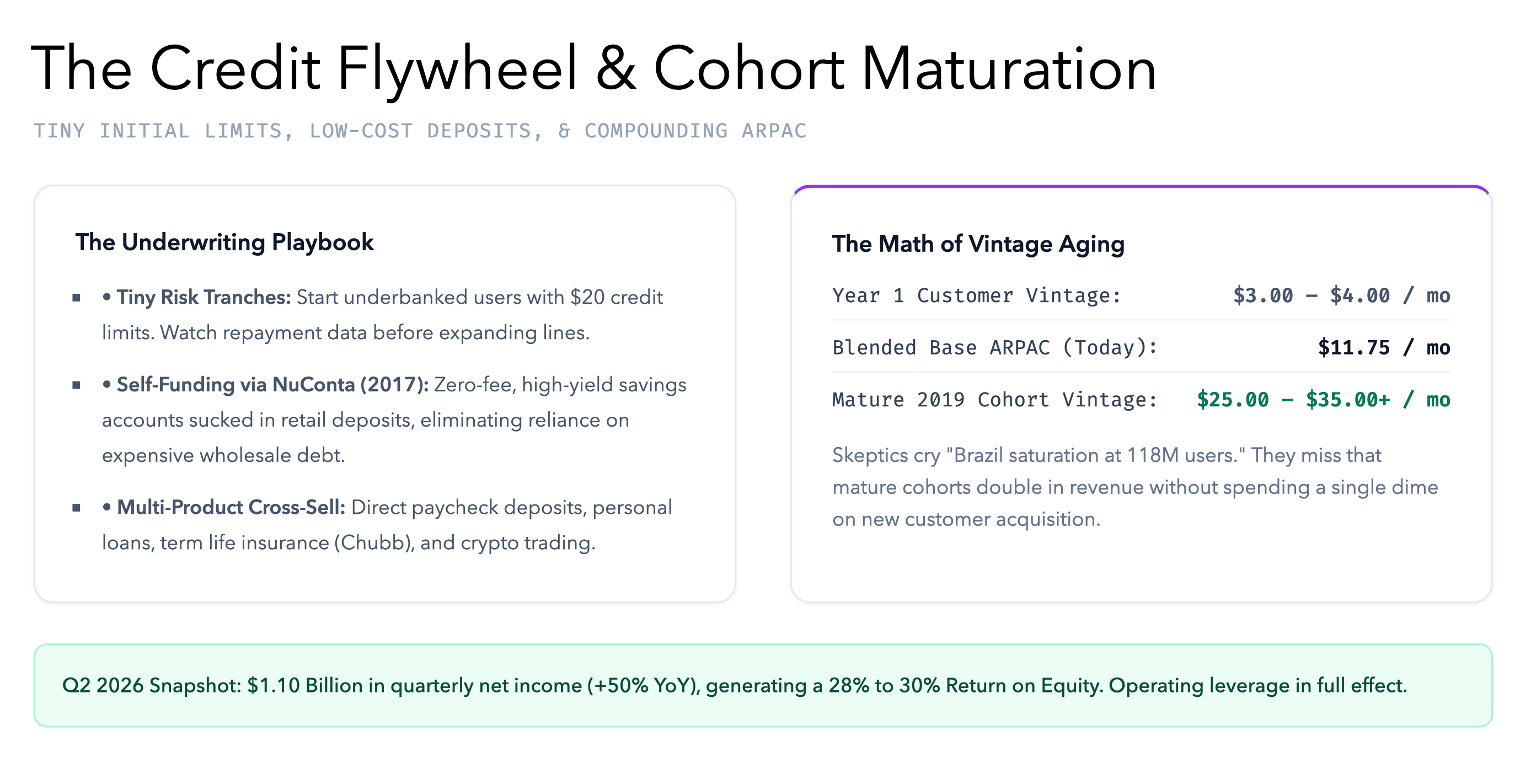
Nu’s playbook combats this by giving out those purple cards to first time credit holders with tiny limits... sometimes as low as $20. They get to see at this essentially riskless scale that a customer will pay their bills. When they do, the credit limit grows over time.
To fund that credit limit, Nu needed a source of low cost funds. They got there in 2017 by creating NuConta, a zero fee high interest savings account. No more borrowing expensive wholesale debt in the open market, they could now fund their own operations entirely.
Year one, the customers in this flywheel of credit and banking generally pull in around $3-4 per month, primarily from swipe fees on their cards.
Nu then encourages them to direct deposit their paycheck. Offers them personal loans if they need it. Allows them to buy term life insurance or trade crypto from the app. All of these slowly add up and monthly revenue, in those older cohorts can grow upwards of $12-15/month.
Best part? The cost to serve remains right around $1.
That’s a ridiculous operating leverage for a bank. The company closed Q2 2026 with $1.1B in net income, a 50% jump from the year before. Return on equity? 28%. Phenomenal for a bank.
One important distinction: cost to serve is not the entire cost of banking with Nu. It measures a specific set of servicing and transaction expenses. Funding costs, credit losses, and other expenses still sit between customer revenue and shareholder profit. The advantage is operating efficiency, not an exemption from banking economics.
Nu can make the operating side of banking cheaper. The investment question is how much of that advantage survives the rest of the business.
Expansion into Mexico & Colombia
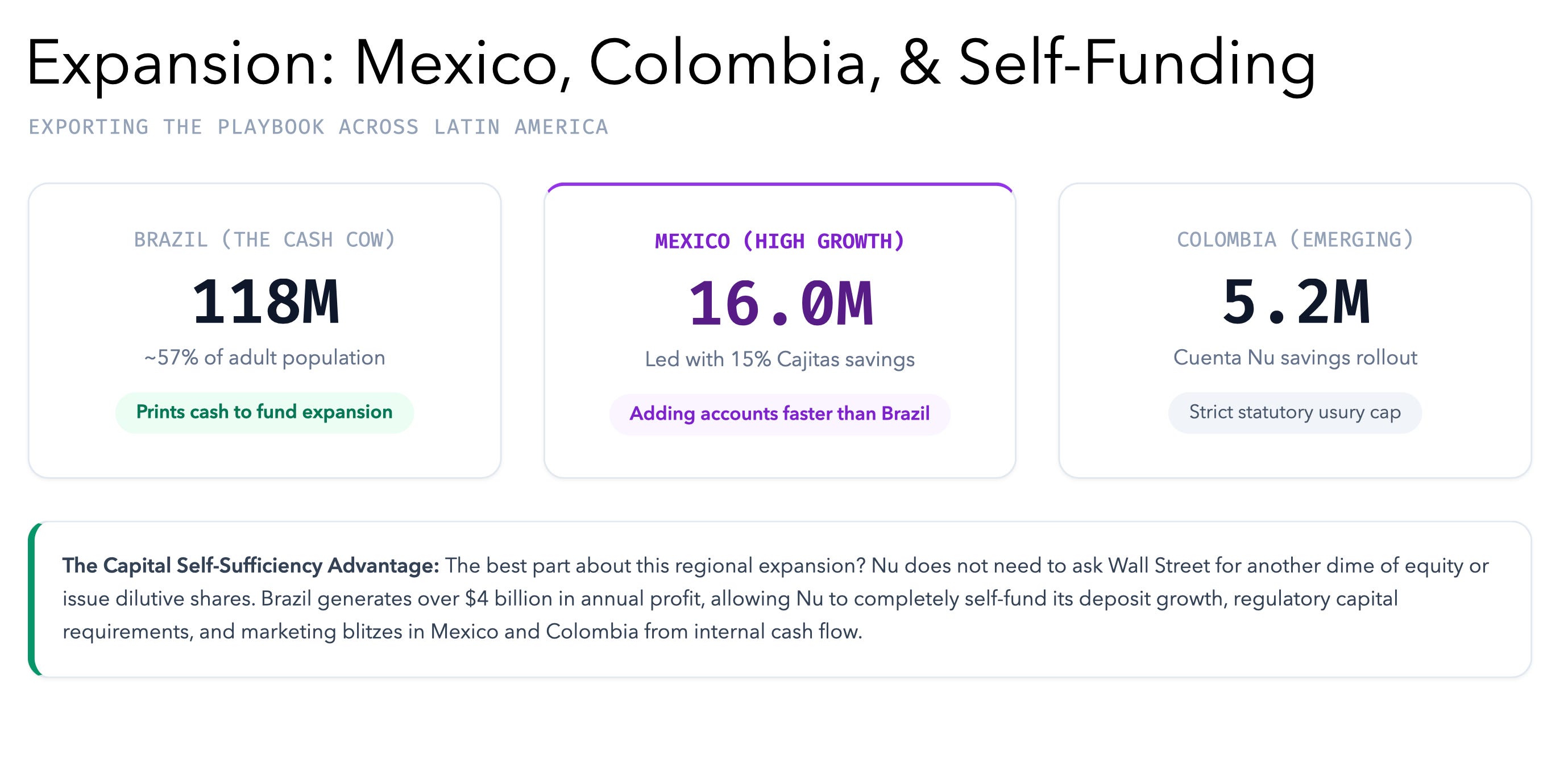
Saturation was reached in Brazil with 118 million customers, well over half of the adult population. So, the next natural step was to take the playbook elsewhere.
Mexico and Colombia were the next two targets. Mexico, arguably, could be an even better target than Brazil initially was. More than half the population have never had a bank account and a lot of daily commerce still happens in cash. The problem: people are skeptical of banks.
Going into Mexico, Nu did tweak the strategy a bit. Instead of going credit first, they led with a high-yield savings account. A beast of a high-yield that paid 15% interest! Billions in deposits showed up pretty quickly.
Hitting 16 million customers in Mexico came pretty quick. Time will tell, as Nu starts scaling back those interest rates, if the people came solely for the initial offer, or if it’s a quick exit once that money doesn’t yield fantastic returns anymore.
On the Colombia side of things, the playbook looks the same. 5 million new customers in that country are helping Nu continue to find higher growth even after saturating home.
The best part of this expansion strategy though? Well Brazil prints so much cash that Nu is able to fund the entire rollout out of its own pocket, no need to ask Wall Street for another dime.
Then What’s Next?
The U.S. market looks to be in play next. I noodled on this for a bit because it’s largely where I start to worry that the story could break down. There’s a 0% chance that Nu can keep customer costs around $1 per month in the U.S., it’s just simply too expensive.
You’re also not going to have much success with even an entry level credit card in the U.S. against the behemoths Chase and American Express that have every single nook and cranny covered.
So, then, what? Well there’s a good amount of workers in the U.S. that send funds back to Mexico. Moving that money can be a little tricky, and sometimes costly. Nu, should they make an appearance in the U.S. could have a very quick in-road right there.
Take funds, make it easy, free, and take zero time to move money to your family in Mexico / Colombia / Brazil who also have a Nu account? They’d see some quick account openings here stateside with that.
Where This Can Break
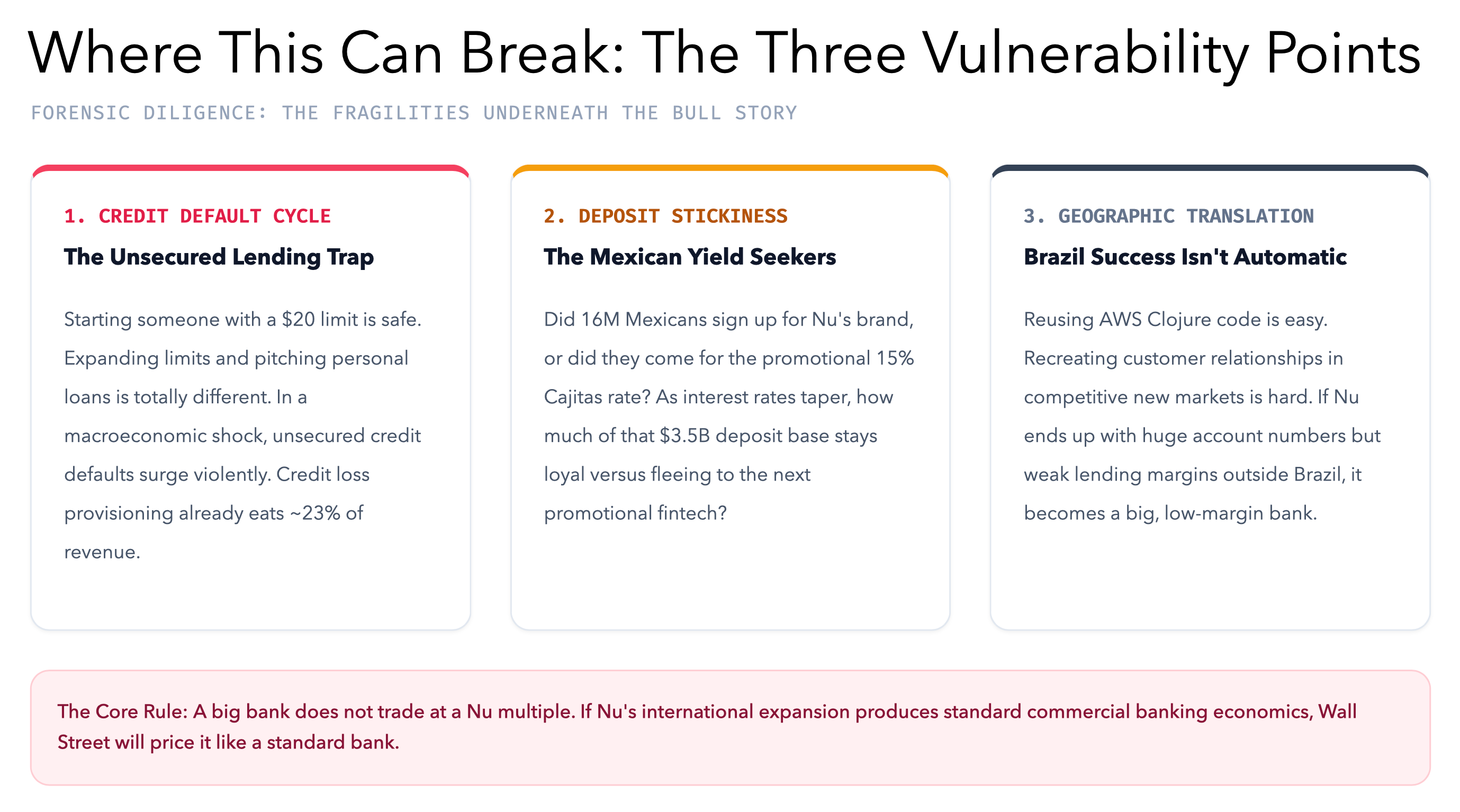
So far there’s a lot to like about Nu. We have a lower-cost way to serve customers, more products to offer them, and countries where the playbook could be re-deployed. But there are places where I’d be careful about assuming the good story automatically.
First: credit.
Starting someone off on tiny credit is great. Increasing that limit and offering them a personal loan is another. What we’d want to see in an investment scenario is that, as lending grows, the repayment story stays the same. Put differently, additional lending should still remain attractive after credit losses.
Second breaking point: cost of deposits.
I raised the question earlier: did Mexican customers come for Nu, or did they come for the artificially high savings rate?
Ideally, the rate gets someone through the door, but the experience has to give them a reason to stay. Nu has not been around in Mexico for long enough to know with certainty the answer to this question, but it’s something we’d need to watch.
Third: assuming Brazil’s success travels automatically.
Reusing the technology is definitely appealing. Recreating customer relationships is much harder. The world has shifted since Nu first got its start. Many other countries have pleasant financial entities now, so Nu is playing in a new (ha!) world everywhere it goes.
An investor should want to see Nu develop attractive economics in new markets, not just impressive account totals. If it’s simply the number of accounts, we end up with a big business that’s less profitable.
A big bank doesn’t trade at a Nu multiple. And that would be a massive problem for any would-be investors to reckon with when they’re faced with a re-rate.
Thank you for reading this far! The rest of the article is reserved for paid subscribers. In it we will cover:
What the economics look like for shareholders
What the valuation tells us today
Our bull/bear/base case
What decision we’re making and whether NU will be added to the portfolio