

This is going to be a three part series. From there, I’m not sure where we’ll take it, but I imagine it’ll be a consistent part of the TechBreakdowns flow.
“It?” Yeah, we should probably start with what “it” actually is.
I’ve long been in love with the investing world, and the tech world hasn’t been far behind it. Throughout my time on the internet I have, at various points, attempted to build a number of investing projects, and TechBreakdowns is another iteration of that.
The rationale going back and forth has been market inspired. I see tech soaring I say “I work in tech, I know tech, I can write about that.” But, when tech takes a turn, my mentality shifts back to what I’ve always been fond of: high-quality.
High-quality can be boring, right? It’s the names that have a system down and they rinse & repeat for many years grinding out little-by-little. It’s that little-by-little that adds up though.
So, what is “it?”
“It” in this case is my clash of two worlds. We’re here on TechBreakdowns to talk about tech, that’s true. There is, however, no reason that it can’t be high quality tech.
I have adapted a couple of methodologies that I’ve long used in my regular portfolios to become tech centric. I’ll use them to guide content and discussion here, as well as utilize them to build a TechBreakdowns portfolio that is built for growth, and lets us sleep soundly at night.
Sure, we may dabble in those high-growth names from time to time, but there will be no chasing the beta.
Three Components
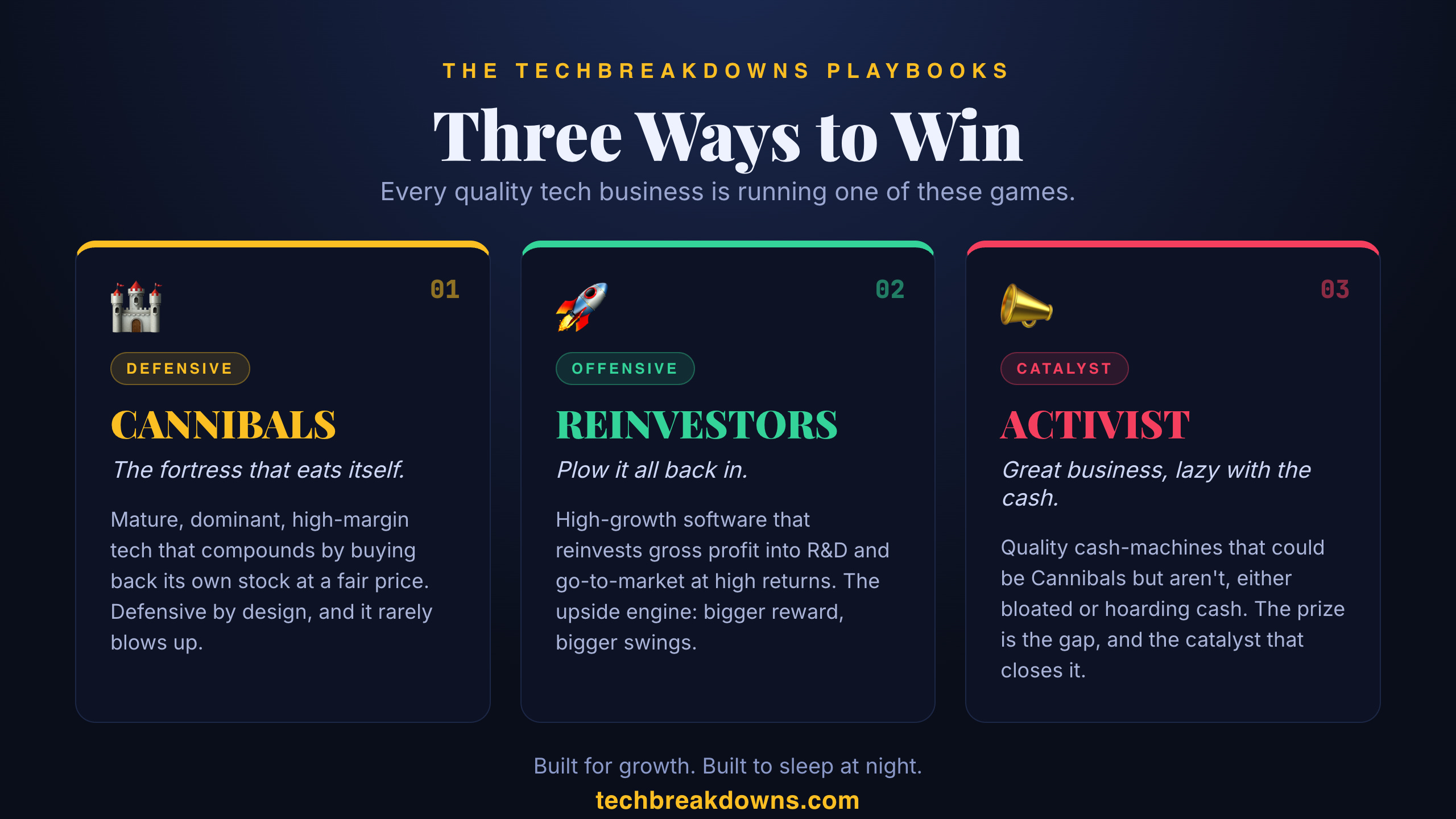
There are three components to the screeners / rulesets. We’ll cover Cannibals today, then move onto Reinvestors in our next piece and end on “Activist.” All three are playbooks. All three were built a long time ago and have been backtested (we’ll talk about that), and all three have undergone a little revitalization to focus on technology.
The Cannibal
In a paragraph, the Cannibal is a mature, dominant, high-margin, cash-gushing tech company that buys back stock at a fair price.
These names are “defensive” by nature. One could easily consider this the ruleset Buffett would quantitatively follow if he were solely interested in tech.
Emphasis, of course, on quantitative. We’re focusing here on finding companies first and foremost, then we’ve got to do the leg work qualitatively.
The question you’re most likely dying to know though is “how does this thing perform?” Well, you’re in luck, because I backtest literally everything.
To backtest this, a “high quality” screener for the tech world, I took the last 20 years of data, accounted for survivorship bias in the data, and then set the rule that any stock meeting what we look for is bought and held for three years.
The benchmark is the entire universe the cannibals are drawn from where market cap is >$1B. Every “Technology” and “Communication-Services” stock is up for grabs. In all, those stocks returned 11.8% annualized.
The cannibals: 16%.
Better yet... average max drawdown was 31% for the cannibals versus 43% for the “tech market.” Better than that? Sure... the “blow-up rate” was just 2% versus 11% for the benchmark (this is the amount of times a buy was down >50%). We also see the doubler rate (stocks 2x’ing in a 3 year period) of 18% versus 16% for the market.
So, overall, fantastic. Now let me be honest about *why*, because it matters: most of that extra return is the “quality premium” — a well-documented factor anyone can tilt toward, not some secret sauce I cooked up. The real prize is the *defense*. You compound right alongside the tech market, but you blow up a fifth as often. That’s a version of buy-and-hold that actually lets you sleep.
In short:
A stock that screened as a Cannibal, bought at any point over 2006–2026 and held three years, returned about 16%/year on average.
How Cannibals Looked Through The Years
A quick look at who was topping the list in some random past years. These companies made the cut, and without qualitative intervention would have been bought and held for three years.
2006
The oldest data we have, but it’s an incredible list that would have returned 1215% over the last 2 decades versus 648% for the S&P 500. A 14.1% CAGR versus 10.8%.
Again, just to call out, buying blindly on quantitative measures...
AND this was on the eve of the GFC. Beating the market, even through that, is considerable. $10,000 would have been $132k, not the $75k invested in the S&P index.
The list included just 9 names: Microsoft, Cisco, Intel, Oracle, Texas Instruments, Applied Materials, Maxim Integrated, Intuit — and, amusingly, Coca-Cola, which snuck into the *tech* screen purely on its fat gross margin (and even it roughly matched the market at ~10%). One footnote: Maxim was acquired by Analog Devices back in 2021, so that slot simply rolls into ADI — a buyout is just another way a Cannibal hands value back to its owners.
2015
11 names made the list in 2015, many familiar: Apple, Microsoft, Oracle, Intel, Cisco, Expedia, Gartner, F5, Jack Henry, Manhattan Associates, Marvell.
Even back then it was boring, but if you’d have bought that portfolio in 2015, you’d be happy in 2026. There are some roller coaster rides in the mix though.
2024
Even going 2 years back there’s a list of very familiar names in the bucket.
Apple, Alphabet, Meta, Adobe, Qualcomm, Applied Materials, ADP, KLA, Cadence, FICO, Verisk, EA, Gartner, Manhattan Associates (again), Dropbox, InterDigital.
Alphabet and Meta were fresh to the list. They’d hoarded cash through COVID and found themselves returning that cash en-masse as they matured. This screen captures the exact moment a company “grows up” and becomes mature.
What Are The Criteria?
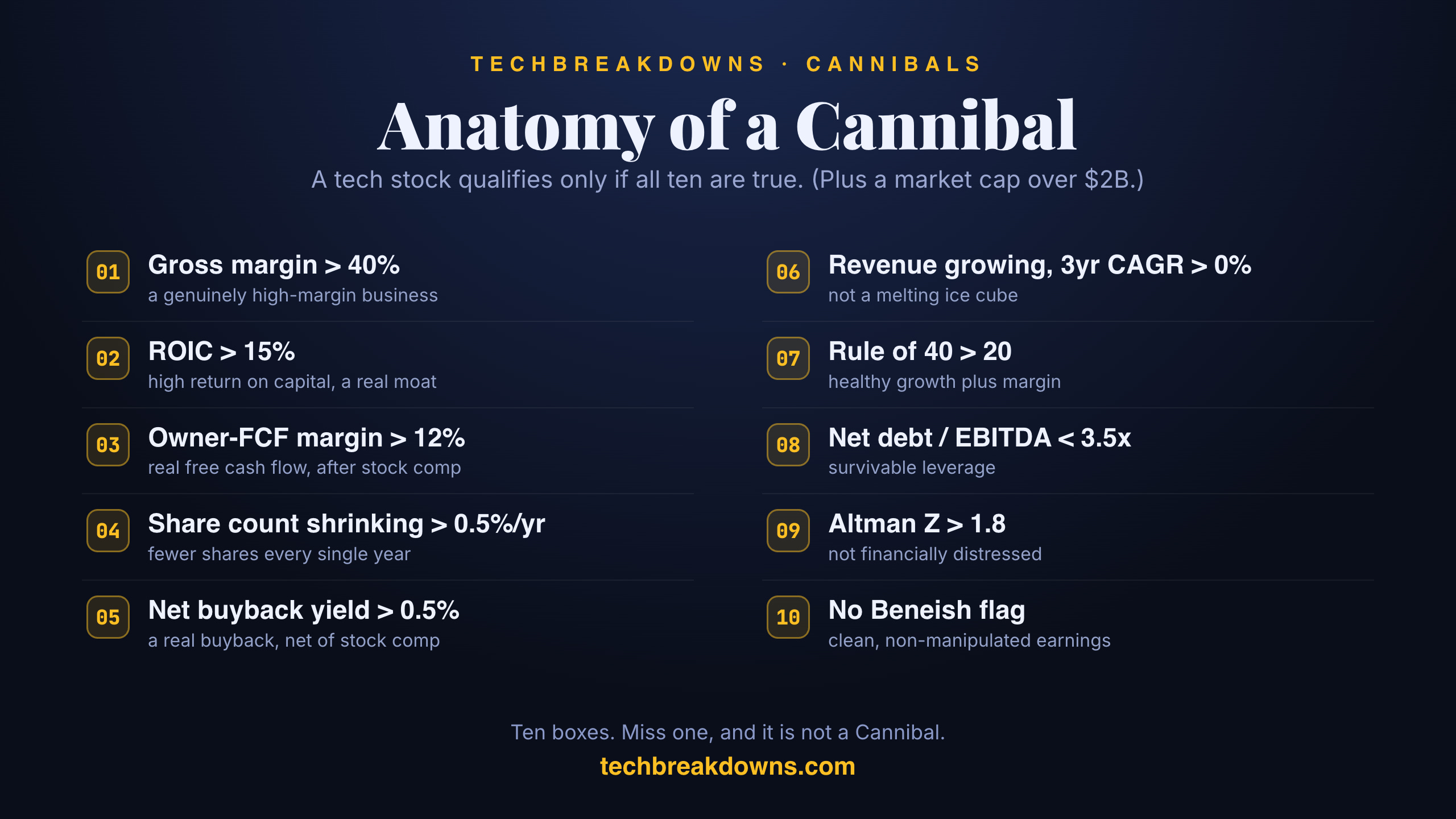
We’ve made it this far but haven’t hit on the criteria, let’s do that. A stock meets our Tech Cannibal screen only if all 10 of the following criteria are true:
Gross margin > 40%
ROIC > 15%
Owner-FCF margin > 12%
Share count shrinking > 0.5%/yr
Net buyback yield > 0.5%
Revenue growing (look for 3yr CAGR > 0%)
Rule of 40 > 20
Net debt / EBITDA < 3.5x
Altman Z > 1.8
No Beneish earnings-manipulation flag
The stock must also have a market cap of >$2B, so I guess that makes it 11 criteria.
At the time of writing there are 25 names that meet what we’re looking for and, going forward, we’ll be covering these companies along with our other investment models to make a trio we can track for the longer term.
Interestingly, two names you might *expect* — Microsoft and Alphabet — didn’t make today’s cut. Both were Cannibals as recently as 2021–24, but their enormous AI and cloud capex has shrunk their net buybacks enough that they’ve quietly slipped back into “Reinvestor” mode. The screen catches companies growing up — and, occasionally, un-growing-up.
Top 10 Tech Cannibals
I’ll leave you with ten names that meet the above criteria. I’ve ranked them using a bit of a weird methodology, but largely focusing on capital returns.
Adobe
Expedia
GoDaddy
Verisk
Fair Isaac
AppLovin
Qualys
eBay
Corpay
Cirrus Logic
The question now turns to the qualitative side for me. We have a lot more names because a lot more tech companies have matured over time, and I’m not sure that buying blindly is going to be beneficial. That’s the point of this publication though, to track that and figure it out.
The complete list of stocks will be provided for paid users below. We’ll also provide the non-tech version of this for those that are curious in our premium data sets. As always, happy to answer questions on the whole thing.
*One last thing, and an important one: none of this is personalized investment advice. It’s research and education — the output of a quantitative screen plus my own opinions. Do your own homework before you buy anything.*