

If you looked only at a spreadsheet, dLocal looks like an asymmetric gift. It shows a ~20x P/E as a payment processor that’s compounding volume at +92% year-over-year. There’s a pristine balance sheet to go along with it, and a rudimentary DCF gives us a 90% upside.
But spreadsheets assume smooth mathematical trends. So, I did what we do here on TechBreakdowns and got right into the name. What I found was a business that is doing a fantastic job of abstracting away the complexities of dealing with emerging market payment rails. As I dug in more, however, I saw some flags worth discussing deeper.
dLocal Explained
In the United States or Europe, charging a customer money is trivial. You can setup on Stripe, Adyen, or one of the other countless mega acquirers available and the user enters a 16-digit Visa for money to transact in seconds.
In Brazil, Nigeria, Indonesia, and many other countries, the path is not the same. The vast majority of consumers in emerging markets don’t have credit cards. There are a multitude of payment options, APIs, rails, and pain points that make moving money a big chore.
So, put yourself in the shoes of a global product manager at Spotify, Uber, or Amazon. You want to be able to accept payments in these emerging markets, but you don’t want to set up a team to build to each and every rail out there. What do you do? You hire dLocal.
When Brazilian customers choose to pay instantly with Pix, it’s covered. If a Mexican consumer wants to use an OXXO voucher, no problem. In Kenya you might find a customer wanting to pay with M-Pesa, a mobile SIM balance, and you can accept that without having to build anything.
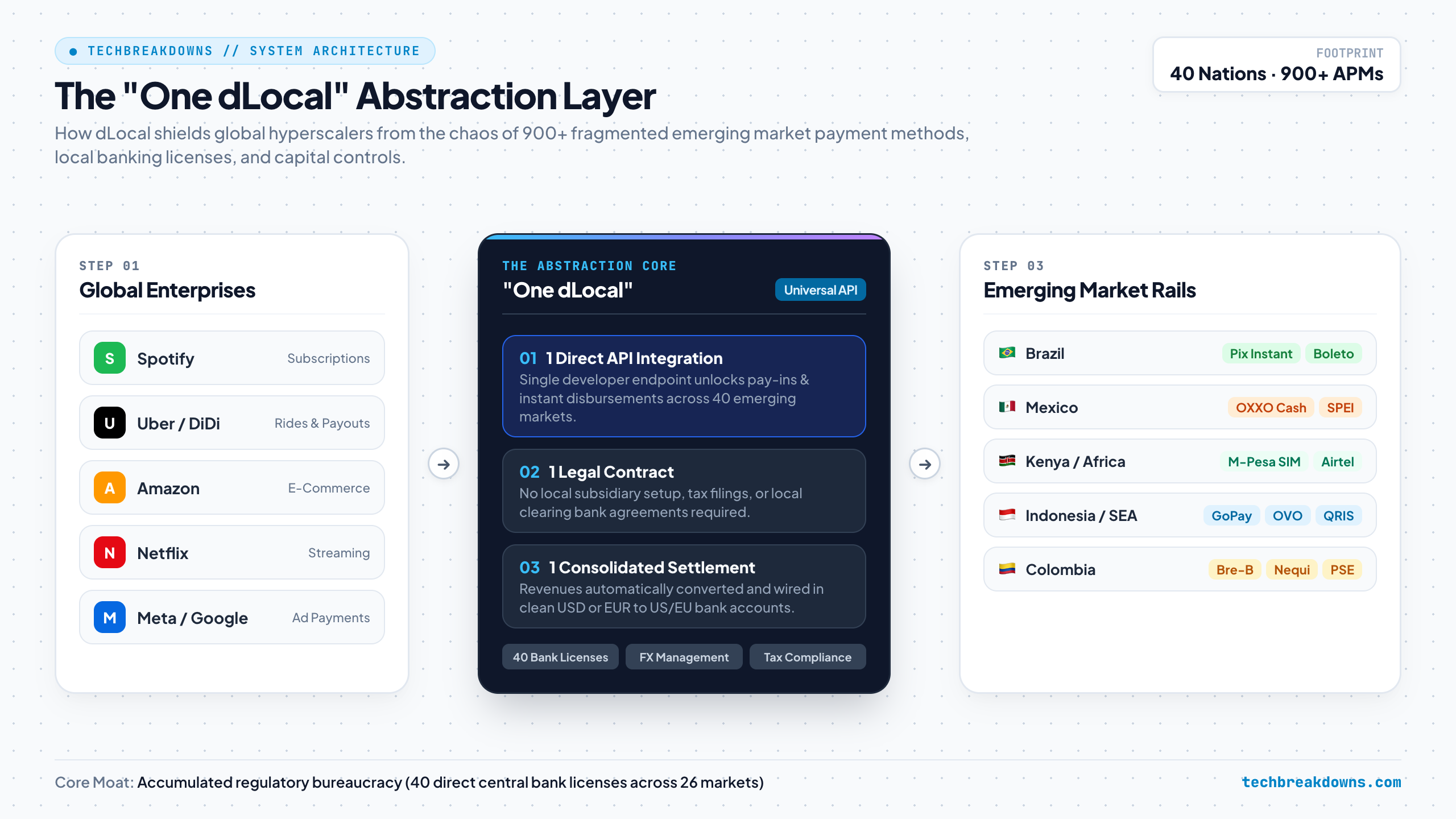
The list goes on. dLocal covers 40 emerging markets and is integrated with 900+ bespoke local banking APIs. The company has the local entities required to transact, the banking licenses each nation needs and they’re able to help navigate foreign exchange capital controls along with filing local tax returns. It is, for all intents and purposes, a payment ecosystem in a box that covers emerging markets.
This can all sound like a lot. If I’m Spotify, how do I work with dLocal? Well, it’s actually quite easy. DLO takes the geopolitical payments maze and breaks it down into three simple promises:
1 direct API integration
1 legal contract
1 consolidated settlement (and payouts in USD / EUR to a company’s local bank account)
Any new nations or payment methods added become instant value adds to dLocal’s customers. Oh! And there’s more value too... businesses that have pay-outs (disbursements) like Uber or DiDi can be handled by DLO as well in the end user’s local currency in real-time.
The Economics of dLocal
The economics of acquirers are always fun to try and figure out. Much like the maze dLocal is trying to navigate when it comes to international payments, analysts (like myself) have to navigate a “who owns what” when it comes to revenues and cash flowing through the companies. Thankfully I got way too deep into the weeds breaking down Adyen a few years back and I already knew my way around a little bit.
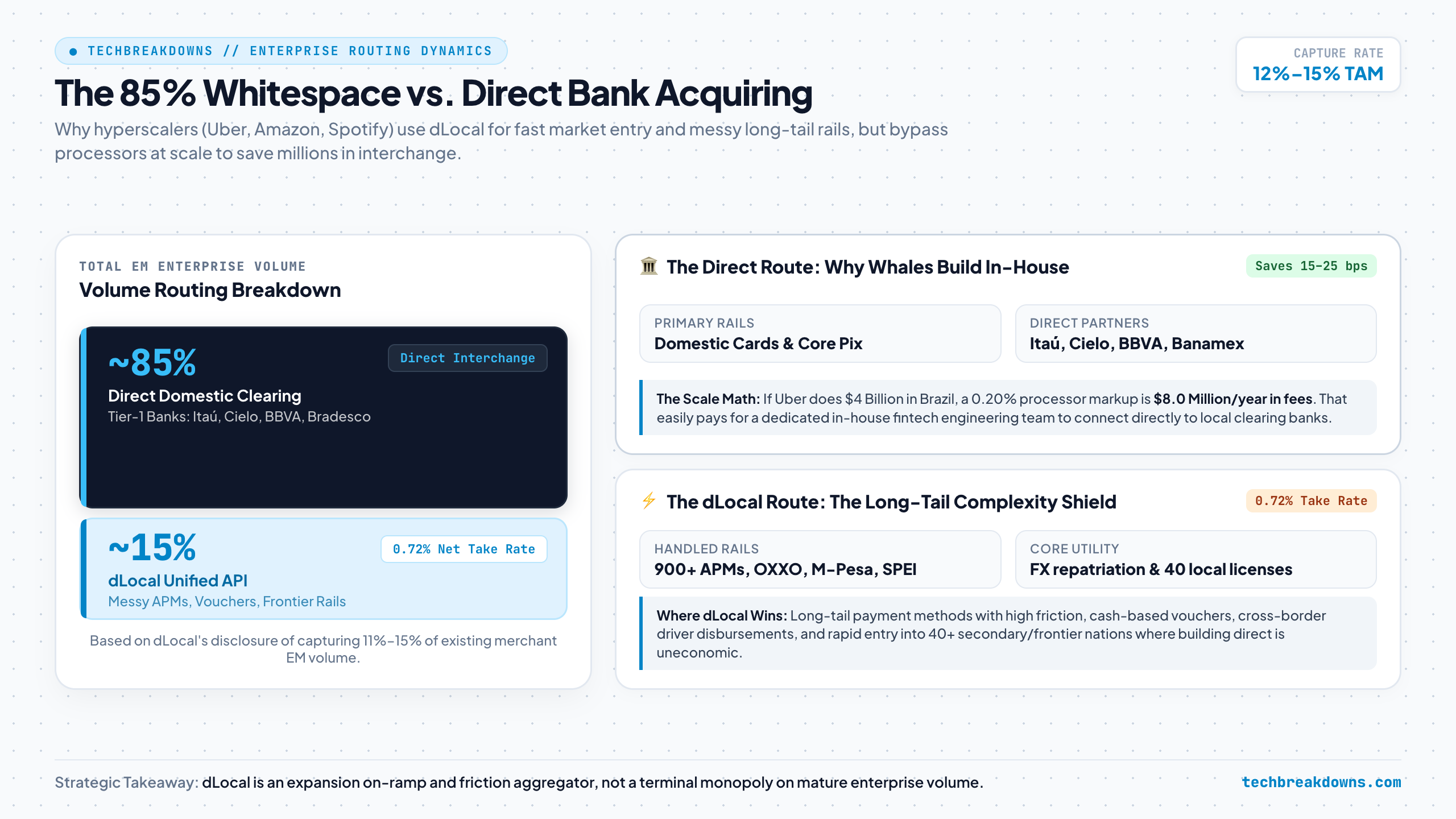
Let’s assume a $100 purchase in Brazil via Pix. dLocal may collect $2.38 off that and book it as gross revenue. A big chunk of that though is what’s called “pass-through interchange” which includes your local bank fees and FX processing costs. In our case we can call that $1.66 which leaves dLocal $0.72.
That $0.72 is what you’ll find on the DLO income statement as gross profit, and it’s the number we actually care about. If we divide that gross profit into the “Total Processed Volume” of $100 we get 0.72% which is the “Take Rate.”
OK, those are the terms we need: Total Processed Volume (TPV) and Take Rate. These tell the story of any payments processor.
And the story we’re seeing here with dLocal is an interesting one. If you look at Q2 2025 the Take Rate was 1.07%. Q1 2026 it’s 0.84%. Q2? It’s that 0.72% that we just outlined.
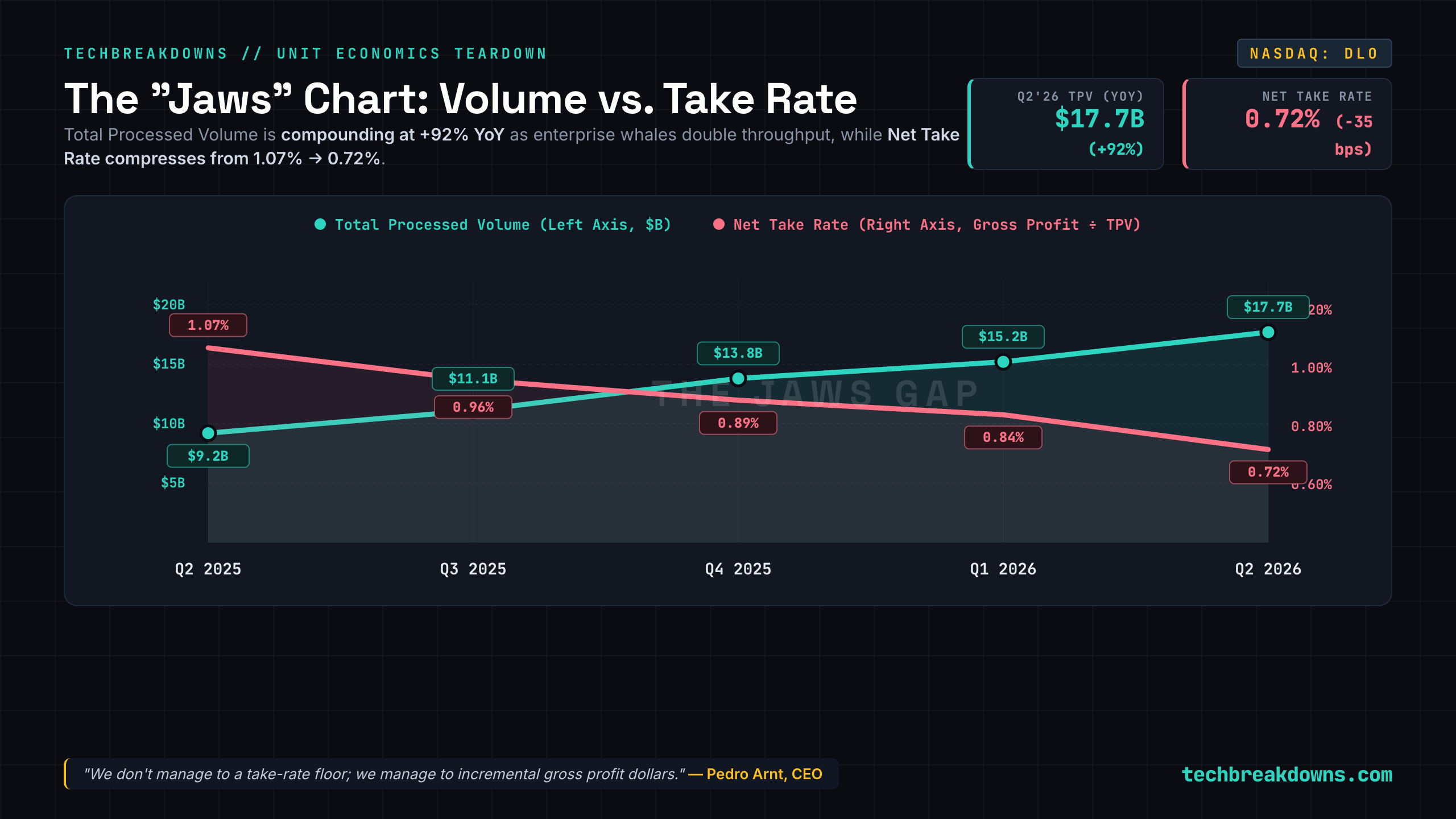
When asked about this significant slip, CEO Pedro Arnt (formerly the long-time CFO of MercadoLibre) said a single massive ride-hailing client (we can assume Uber or DiDi) doubled volume which triggered pricing step-downs. Both a good and a bad.
Asked further, Arnt told analysts on the call “We don’t manage to a take-rate floor; we manage to incremental gross profit dollars.”
The Customer Dilemma
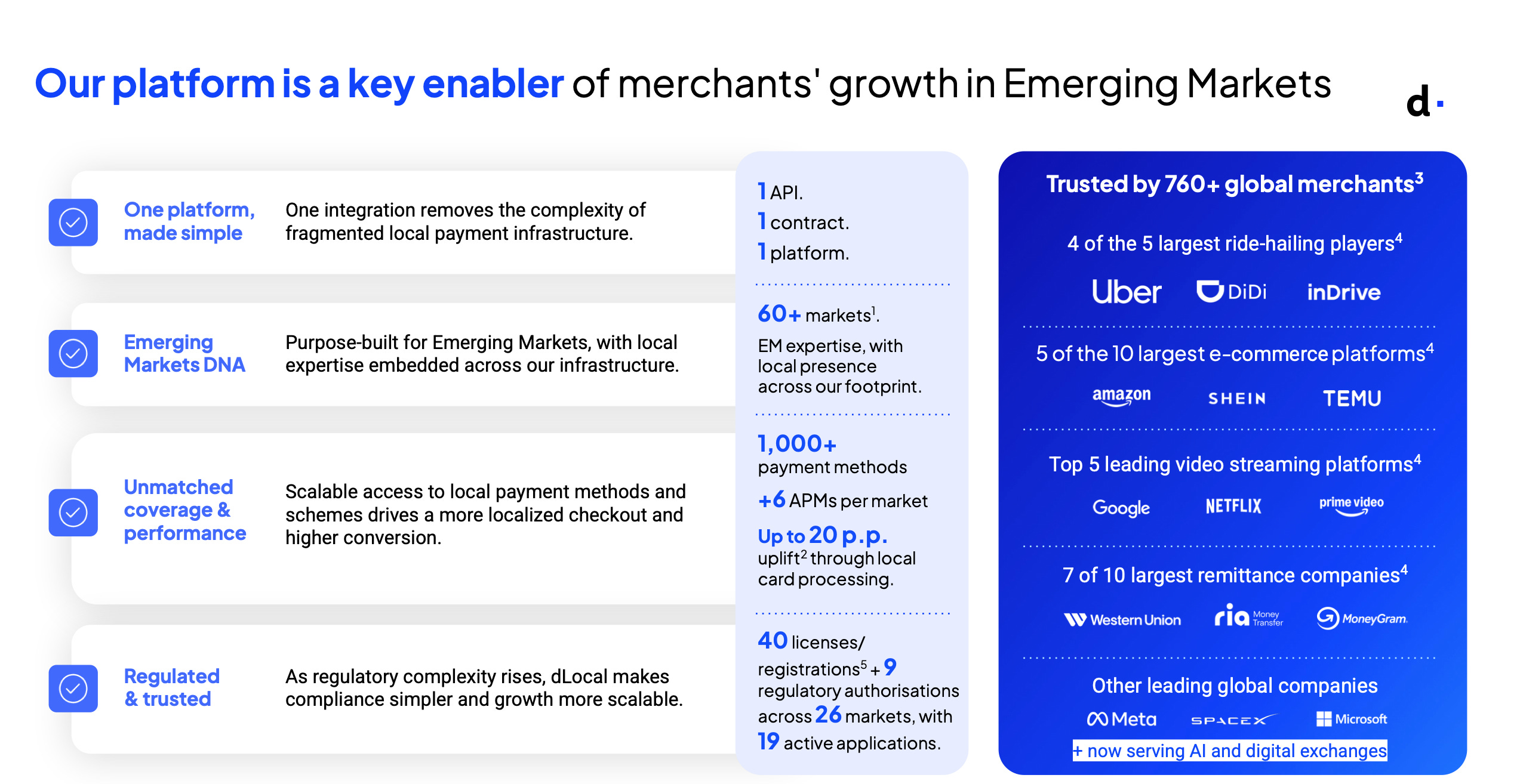
Looking at the “logos” that sit on the slide decks of dLocal you’d be blown away that it’s a name you’ve never heard of. They’ve got 4 of the 5 largest ride-hailing giants, 5 of the 10 largest e-commerce platforms, and the top 5 streaming platforms.
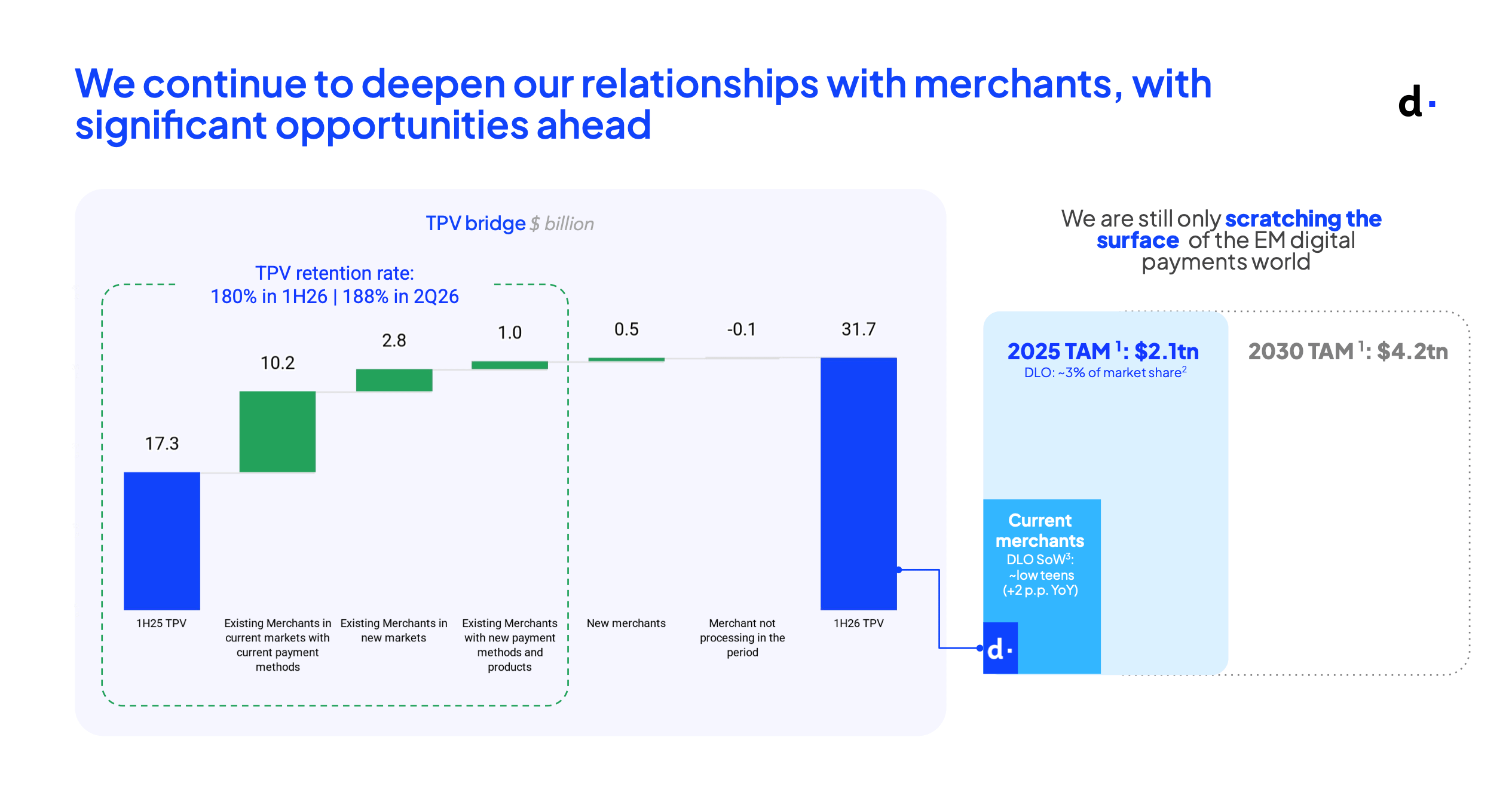
The company is also posting a massive 188% TPV retention meaning that those existing clients are growing at a significant clip on dLocal’s platform. The math here, by the way, for every $1 equivalent last year existing customers are bringing in $1.88 this year. That’s unthinkable same customer growth.
From my research though, I believe this falls apart in a few critical ways:
Customers demand lower costs
Customers have cheaper options
Payments will consolidate
Customers Demand Lower Costs
We see this already playing out. Customers expand and they already have negotiated contracts to provide lower rates with that expansion. This in itself is not a negative thing but when combined with the second bullet point customers having cheaper options dLocal has no other alternatives except to comply.
Customers Have Cheaper Options
A company like Uber might choose to use dLocal to enter a market but unless dlocal continues to provide lower pricing for a company like uber once the company reaches a mature scale it may choose to go direct and build its own payment rails to save on the margin.
If a company like Uber is doing two, three, or four billion dollars of revenue in a country, it makes more sense for Uber to build its own payment rails to start capturing back the 0.1% or 0.2% it may save by doing so. That 0.1 or 0.2% on billions of dollars works out to a meaningful sum of money in the market.
Sure it might not be able to tackle all the payment methods that dLocal does but by operating in the market it will see what payment methods customers prefer and then be able target majority of those.
Better yet is bullet point three where payments will consolidate over time.
Payments Will Consolidate
Over the coming years these emerging markets will consolidate onto a handful of payment methods that work for the majority. When they do consolidate onto that handful of payments it makes market entry easier for the acquirers that large multinational companies are already working with like Adyen to get a better foothold in the market.
I see all three of the reasons above as key things working against DLO over the long-term. Sure the economics look great now And you cannot argue that dLocal is growing at a phenomenal clip But when it comes down to long term growth and how this company will succeed over the coming five or ten years I believe we’re more likely to see struggles than easy success.
The DLO Moat
I always like to make sure we cover the moat and talk about what sets this business apart for dLocal it is dealing with regulatory bureaucracy not necessarily the technical implementation.
And we’ve mentioned Adyen a few times in this article but comparing it to Adyen, Adyen is perfect from a technical implementation standpoint deals with regulatory stuff too But where dLocal stands out is on making sure that it can operate in all the markets where nobody else wants to deal with the red tape.
dLocal holds 40 direct central bank licenses across 26 markets, and operates directly in 39 markets in total with 217 integrated APMs (different payment technologies).
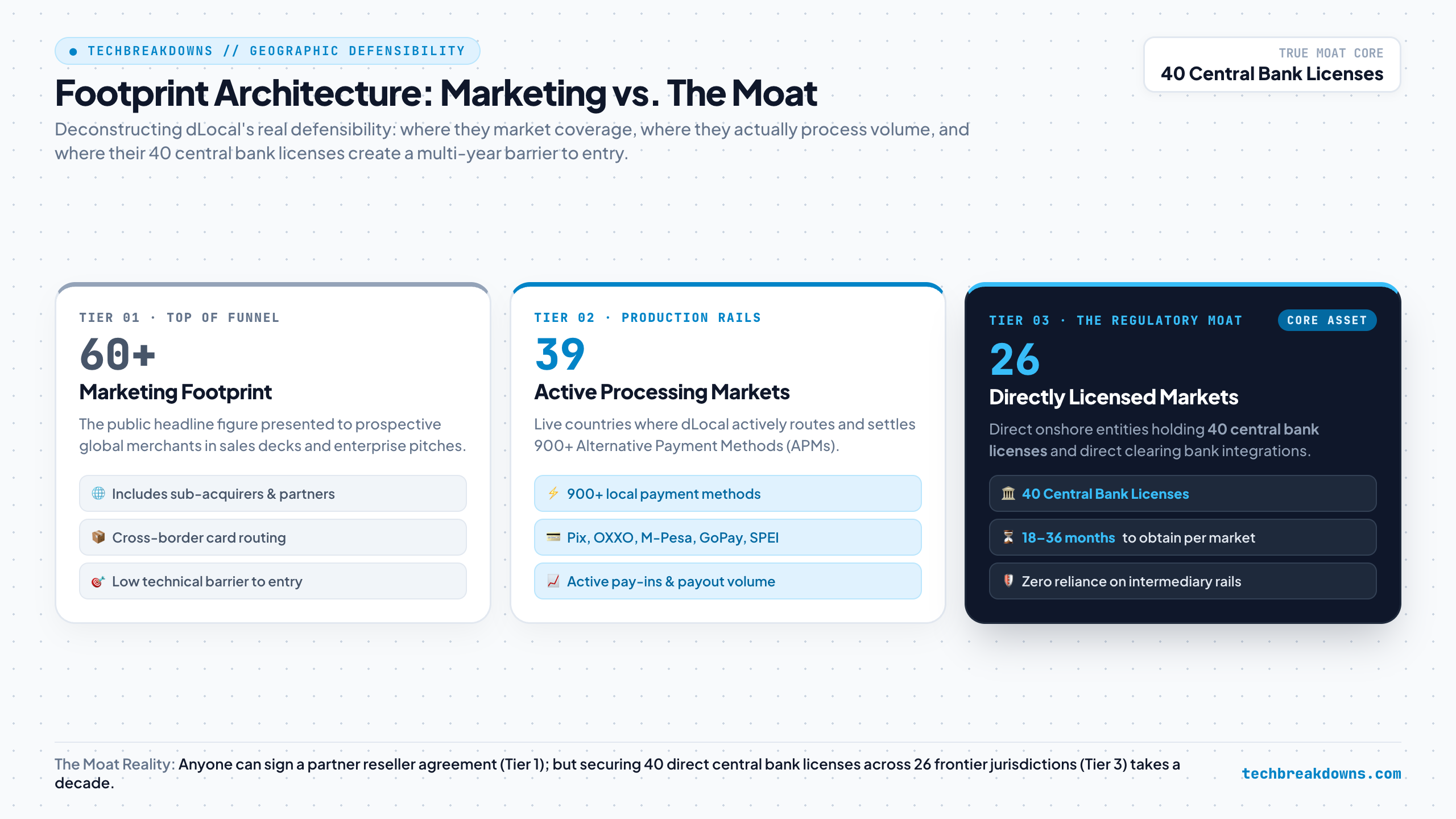
The moat is all the accumulated regulatory bureaucracy, local banking clearing accounts, the merchant of record compliance in all these different nations. It would take a company like Uber or Spotify 18-24 months and millions of dollars in collateral to get a central bank license. They don’t want to do that, so they need a partner, and dLocal is a partner they can pick across those 39 different markets.
As mentioned above though, that terminal vulnerability is the standardization of payments. Pix in Brazil, UPI in India, Bre-B in Colombia. These rails make the difficulty of collecting local payments go down, and an easier market erodes dLocal’s complexity premium.
The Financial Snafu
Finally before we dive into the premium portion of the article I did just want to call out what i consider to be a fantastic financial snafu.
dLocal is a fast growing company that has a 3% market share in the areas it operates. The company also believes it only has somewhere around 15% of its existing customer TAM. Sounds like a great position to be in, and a position where you’d want to, as a business, re-invest your cash to capture that market.
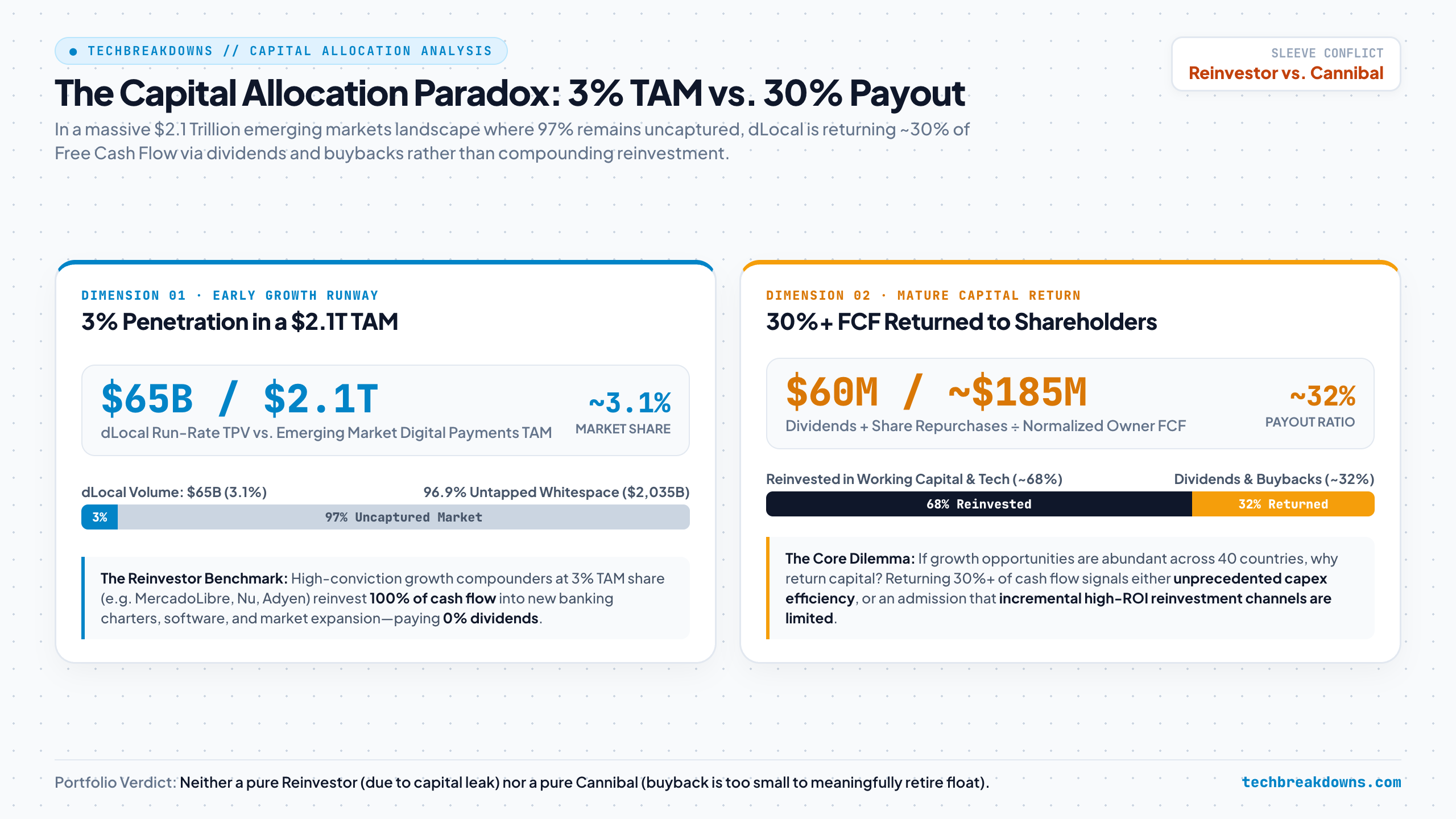
Instead of reinvesting in the business, dLocal has a dividend and share buyback program that’s returning 30% of FCF to shareholders.
Returning cash is better than funding low-return projects, but by all accounts there should not be low-return projects in this business. A true reinvestor or moonshot would be focused on building a massive business and then focus on returning capital once they get there.
I hope you enjoyed the article. Up next, if you’re interested in more, our premium subscribers will get a look at the owner economics, a float reality check, the valuation, and our verdict on whether to add this to our portfolio.
Disclaimer: Not personalized investment advice.