
NXP vs. Apple and the Unit Economics of a Tap
How Apple turned a $3 supplier chip into a $5.6 billion infinite-margin toll booth

This is a premium extension of Part 1: The Invisible Handshake, where we broke down the “dead computer” inside your credit card and the cryptographic handshake that happens every time you tap. If you haven’t read that yet, start there. This piece picks up where that one left off: the companies behind the chip, the money flowing through the tap, and what happens when the company that built the infrastructure meets the company that learned to monetize it.
Also… it’s free to demonstrate what premium content will look like, hope you enjoy!
NXP Semiconductors co-invented NFC. Their silicon sits inside every iPhone that’s ever processed an Apple Pay transaction. When you tap your phone at a coffee shop, NXP’s chip generates the one-time cryptographic proof that the payment is real.
Apple pays NXP somewhere between $3 and $5 for that chip. Once. That’s the last dollar NXP ever sees from that device.
Apple collects 0.15% of every credit card transaction that phone processes, for its entire useful life. On roughly $7.6 trillion in global Apple Pay volume in 2025, that fee generated an estimated $5.6 billion in revenue. NXP’s entire Mobile segment, across all customers and all products, did $1.6 billion that same year.
Think of it like the music industry. NXP is the session guitarist who played the riff on a hit record. Flat studio fee, move on. Apple is the label that owns the master recording and collects royalties on every stream, forever.
NXP Is Not What You Think
Most people hear “NXP” and think payment chip company. That’s about 13% of the story.
NXP Semiconductors (NXPI) is a Dutch company trading on the NASDAQ with $12.27 billion in FY2025 revenue. Here’s where it actually comes from:
Automotive: $7,116M (~58%)
Industrial & IoT: $2,273M (~18.5%)
Mobile: $1,584M (~12.9%)
Comms & Other: $1,296M (~10.6%)
NXP is an automotive semiconductor company that also makes the chip inside your iPhone. The Mobile segment where Apple lives is less than a quarter the size of Automotive. That distinction matters for everything that follows.
The automotive business is built on radar sensors for ADAS, processors for software-defined vehicles, and power management for EVs. NXP shipped roughly 170-180 million automotive radar sensors globally in 2025 and forecasts 8-12% compound annual growth through 2027, with the EV and ADAS segment targeting 15-25%. That $7.1 billion segment could be $9-10 billion by 2028.
They’ve been building this moat deliberately. NXP knows exactly what Apple does to suppliers. They’ve been watching.
Apple’s $5.6 Billion Toll Booth
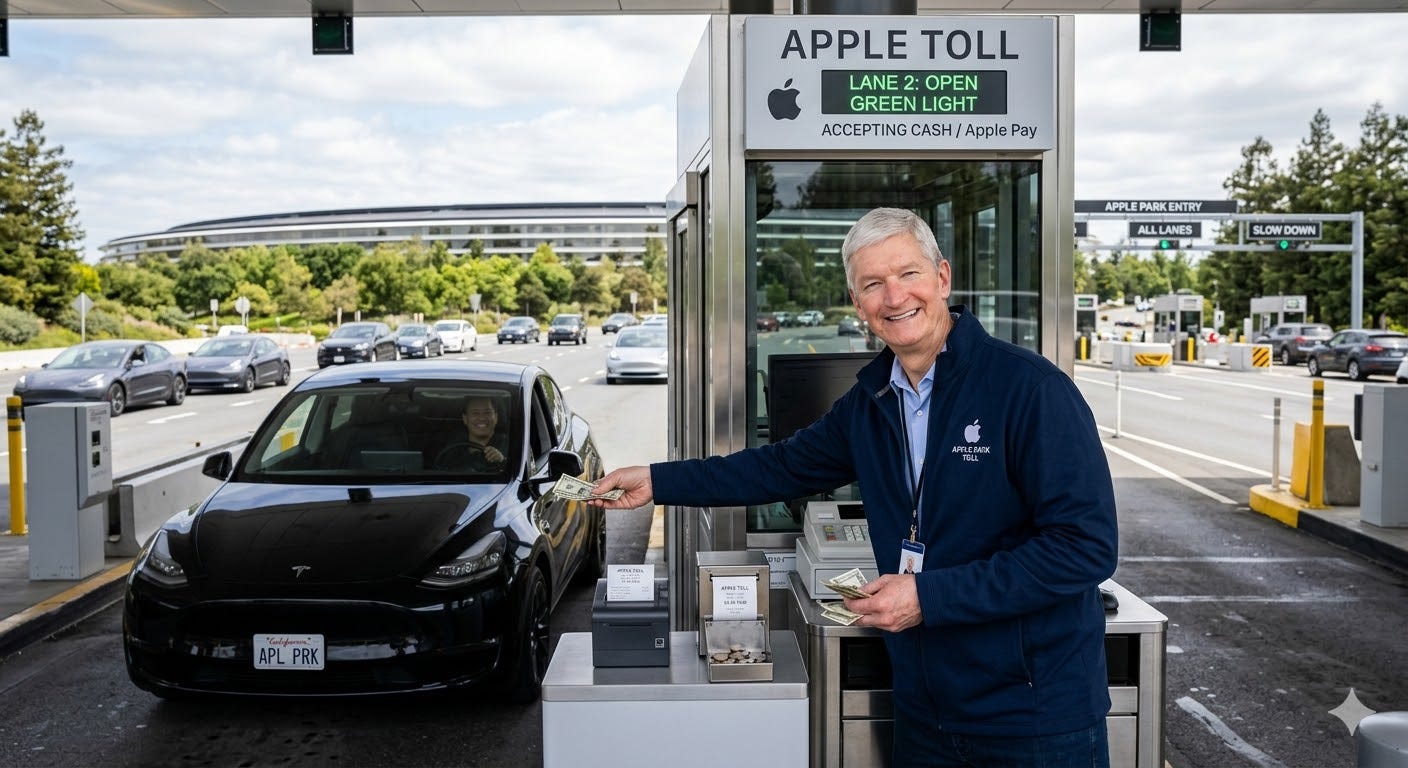
Apple charges issuing banks 0.15% on every credit card transaction through Apple Pay, plus $0.005 per debit transaction. Your bank pays it. You don’t see it. Google doesn’t charge an equivalent fee. Samsung doesn’t. Only Apple does, because only Apple controls the hardware-software stack tightly enough to demand it.
The numbers are genuinely striking.
Apple Pay processed $7.6 trillion in global transactions in 2025, up 21% year-over-year. At 0.15% on credit, the conservative fee estimate is $5.6 billion. Apple’s Services segment did $109.16 Billion in FY25 Apple Pay fees are roughly 5-6% of that.
Here’s the part that makes the dynamic click. That $5.6 billion has essentially zero cost of goods sold. Apple doesn’t process the payment, hold the funds, or manage fraud. The banks do all of that. Apple provides the secure hardware environment, collects 0.15%, and moves on. The margin is close to 100%.
NXP sells Apple a $3-5 chip, once. Over a 3-year iPhone lifecycle, Apple’s cumulative fee revenue from a single device exceeds that chip cost by a factor of 100 or more (worth sitting with for a second). NXP captures the hardware margin. Apple captures infinite-margin software rent.
Apple’s Very Consistent Habit
If this were one relationship, it’d just be an interesting asymmetry. But Apple runs this play on every critical supplier.
Imagination Technologies made the GPU cores inside every iPhone for a decade. April 2017: Apple announces in-house GPU design. Imagination’s stock drops 70% in a single day. The company sold itself to private equity months later.
Dialog Semiconductor made iPhone power management chips; Apple acquired $600 million of their business and absorbed 300 engineers.
Intel’s modem division was bleeding money as a single-customer business; Apple bought the whole thing for $1 billion.
Qualcomm’s cellular modem is being replaced right now by Apple’s in-house C1X, with the C2 arriving in 2026 and the C3 expected to surpass Qualcomm’s performance by 2027.
Broadcom’s WiFi chips were replaced by Apple’s new N1 WiFi chip.
The playbook: source from a specialist, learn the technology, dual-source to compete them on price, then design your own chip once the tech matures.
The Secure Element Question
Gurman has reported on Apple’s goal of consolidating all connectivity into the main SoC: modem, WiFi, Bluetooth, NFC, and eventually the Secure Element. The modem and WiFi chips came first. The SE is next.
There are real barriers. Payment chips need EMVCo certification, Common Criteria evaluation, and card network approval from Visa and Mastercard. When a card is manufactured, a Master Derivation Key gets burned into the silicon; your bank keeps a copy. Apple would need to become a certified, trusted party in that chain. And Apple’s existing Secure Enclave (which handles FaceID and TouchID) is a different chip with different certification requirements. Building one doesn’t mean you can build the other.
These are genuine complications. They’re also the kind Apple has been clearing for a decade. They spent over $10 billion developing in-house modems. The SE is a smaller problem than cellular. Realistic timeline: 2028-2029.
What This Means for NXPI
Here’s my take. Apple brings the SE in-house, probably by 2029. When that happens, NXP loses the iPhone NFC/SE socket. The at-risk revenue is real: $3-5 per chip, 230 million iPhones, NXP capturing roughly half the sockets due to dual-sourcing with STMicroelectronics. Call it $350-700 million for the NFC/SE socket, $700 million to $1.2 billion when you add UWB and Apple Watch components. On a $12.3 billion revenue base, that’s a 6-10% hit.
That’s manageable. Imagination had 50%+ Apple concentration. NXP is at 6-10%. When the announcement comes, expect a 10-20% stock correction on the narrative, not a wipeout because everyone sees it coming already.
The more interesting variable is the regulatory wildcard. The EU’s Digital Markets Act has already forced Apple to open iPhone NFC to third-party wallets in Europe. If US regulators follow, Apple’s incentive to spend billions building an in-house SE weakens: why protect a fee you’re being forced to lower? That scenario delays the timeline, which is quietly the bull case for NXPI.
Either way, NXP’s automotive moat is the story. A company growing its $7.1 billion Automotive segment at 8-12% annually doesn’t live or die on an iPhone chip. The stock trades at ~$195 a Strong Buy consensus from analysts. The Apple overhang compresses the multiple. If you believe automotive growth compensates for the eventual Mobile hit (and the math says it does), that overhang is the buying opportunity, but it’s hardly a smooth ride, nor a sure thing.
The Riff and the Royalties
NXP, Infineon, and a handful of companies spent decades building the physical trust layer that makes digital payments work. They invented NFC. They designed silicon that destroys its own keys if someone probes it with a microscope.
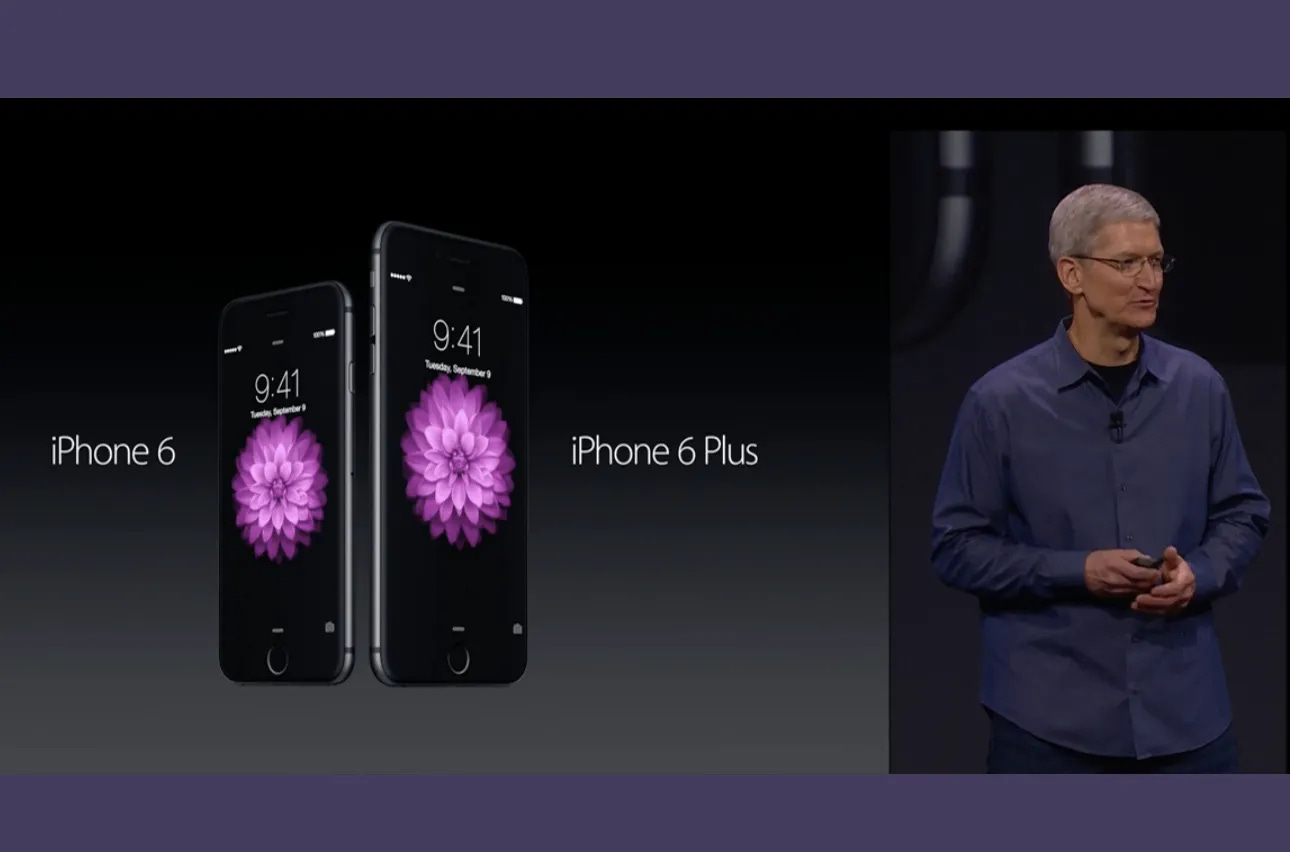
Tim Cook walked into the room in 2014 with the iPhone 6 and an NXP chip inside it. Within a decade, Apple had installed a 0.15% toll on every credit card transaction flowing through that chip. The company that built the trust captures the hardware margin. The company that controls the consumer relationship captures the software rent.
NXP played the riff. Apple owns the master.
That’s the structural story of modern technology in one line. It’s playing out in your pocket, ten times a day, every time you tap.