

In our last post we spoke about Tech Cannibals. Investments in tech companies that are consuming themselves, and positioning your portfolio for a massive windfall, albeit years down the line. They let you sleep safe at night though.
Cannibals shrink to win. Today’s topic is Tech Reinvestors and they do the opposite. They feed every dollar back into the machine. Both compound, they just take different paths towards doing it.
Tech Reinvestors Explained
I think the reinvesting analogy outside of tech helps make this a little more understandable, and there’s no better company to point to than Costco.

Costco has a fantastic product. They build a warehouse, gain a ton of members, keep them happy and then parlay that cash into another warehouse. Soon, assuming Mike Judge was right, Costco will be our everything.
That reinvestment is what has set Costco stock apart over the years. It has a template, it takes the cash it earns and reapplies that template somewhere else in the world. Well, it’s a little harder for tech companies, but we found a way to screen for them all the same.
How They Perform
Much like the Cannibals, we have back tested this thing. 2006 through to 2026, buy and hold for 3 years any stock that meets the criteria (which are below).
Overall annualized return came out to 15.7%, max drawdown was a whopping 44% but the doubling in 3 year number was 22%.
When compared to the entire tech universe that we could have selected from, the total return there was 11.4%, same max drawdown, and a 16% doubling rate.
Overall, the screen performs better than the cohort of tech that we’re selecting from.
Interestingly though, unlike our cannibals, these stocks do not serve us well if we buy and hold “forever.” Extending out the hold to forever leads to a 12.9%/yr return.
Why the split? Reinvestors tend to carry a premium (just look at Costco in our example). They win for a few years, marry them for a decade though and the market chooses to re-rate. This portion of our portfolio then ends up being, largely, a rotational portion.
In short, reinvestors beat the tech market, 22% of them double. But, buy-and-hold them forever is not a path to success. We own them for diversification, rotate when the timing is right.
We’re Qualitative Geniuses!
It did get me wondering... tech has been phenomenal, this screen averages ~30 names per year (2 on low end 51 on the high). What if we were actually qualitative geniuses (hey, we’re going to try and be), how would we have performed?
The results are inspiring, and honestly are going to make me show up and actually put in the work right here to be correct. But, if we were to split the stocks right down the middle, and we were able to select the best half every time, holding again for 3yr our return becomes 30.7%. And here’s the real kicker: that top half had a 0% blow-up rate, while the bottom half lost more than half its value one time in five. The edge isn’t picking the winners, it’s not stepping on the landmines.
Just for fun, the absolute ceiling: if you could somehow nail the top 3 stocks in the cohort every single year, you’re up to a 51.5% annualized return. Nobody picks the top 3 in advance, though, so file that one under fantasy.
We don’t need the fantasy, though. Nail the achievable 30% from today onwards, starting with $100k, and you land north of $20M by 2046. (The perfect-foresight version would clear $300M, but I’m not going to promise you something no human can actually do.) Sign me up for the ride either way.
The Criteria We’re Looking For
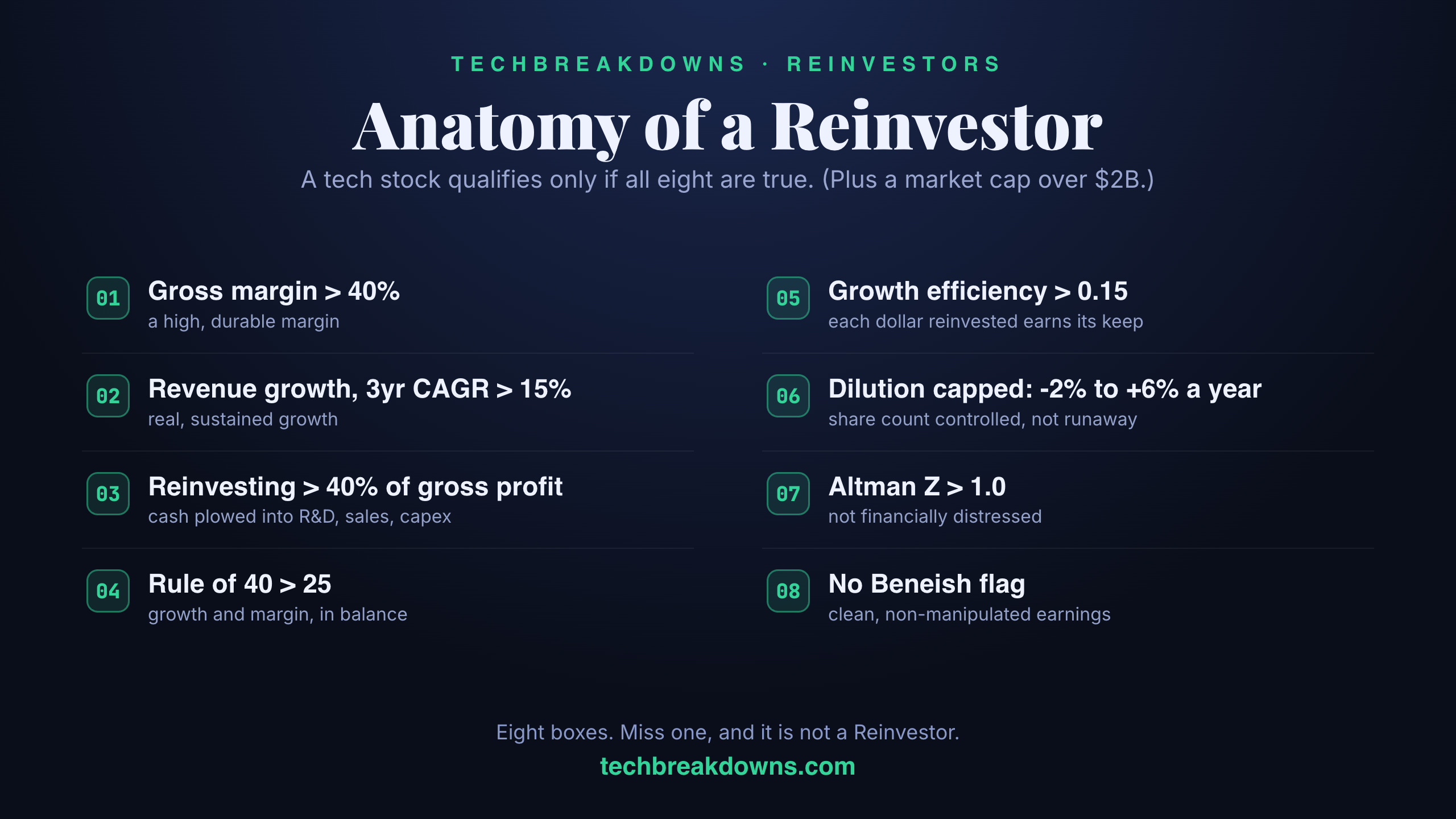
Super simple set of criteria, all gates need to be true to pass. We scan the universe of U.S. listed $2B+ market cap tech companies. From there we’re looking for:
Gross margin > 40%
3-yr revenue CAGR > 15%
Reinvestment rate / gross profit > 40%
Rule of 40 > 25%
Growth efficiency > 0.15
Share count growth -2% up to 6% (nice and controlled)
Altman Z > 1.0
Beneish M < -1.78
In plain English: high, durable margin, real growth, and genuinely plowing money back into the business.
What’s the list look like?
Like with the cannibals, here’s a teaser of what meets the criteria. If you’re a premium user the full listing should show up on this page, and we’ll maintain a semi consistent updating version in the datasets.
In total 35 names hit the criteria today. Here’s ten of them for those reading for free:
MercadoLibre
PDD Holdings
Klaviyo
Global-e
Trip.com
GitLab
Zscaler
Taiwan Semiconductor
Rambus
Kanzhun
Next Up
From here I want to go ahead and start diving in. There is a third pillar, the “Activists,” that we’d originally planned as a full piece. Honestly though, it’s the minor one (the numbers say it only pays off when a human spots a real catalyst), so it’s better folded into a breakdown when the setup shows up than given its own post.
If you’re interested in following the journey, consider signing up for a premium subscription. The goal from here on out is to push toward that 30% (the top-half number, if our selection is good) in as sleep-well-at-night a manner as we can. We’re not chasing moonshots; we’re breaking down genuine companies and the resilient businesses they’ve built.
From time to time, sure, we will dive into some interesting high-growth tech, but that’s a very speculative slice we’d never let exceed 5% of the portfolio, and only if we ever dabble at all. Sleep well, get big returns is the goal and it all starts fresh in August 2026!
*Everything here is research and a model portfolio we track in the open, not personalized investment advice. Do your own work before you act.*