The “Unhinged” Owl That Keeps You Coming Back For More

How long is your Duolingo streak?
I hit a year on mine, but eventually, life got in the way. My wife, on the other hand, is currently over two years strong. And if you go on Reddit, you'll find people deep into the thousands... users who’ve been at it since Obama was President.
This shouldn't be happening. Education apps, by design, are supposed to be boring. Everyone wants to learn a language, but when it comes down to actually doing the verb conjugations, quitting is infinitely easier. Usually, the moment you stop "feeling" progress is the moment you delete the app.
But Duolingo is different. It has cracked the code on getting millions of people to do something difficult every single day, often for years.
There is a running joke that Duolingo users care more about the streak than the language itself. And honestly? They might be right. Perhaps "learn" should be in quotes here, because even after several years, many die-hard users find themselves unable to hold a basic conversation in Spanish.
But I don't believe this is a bug. I think it's the feature.
Duolingo didn’t solve language learning. They solved quitting.
In today’s breakdown, we are going to look at the business of the unhinged green owl. We'll explore how they turned "guilt" into a retention strategy, the hidden monopoly they are building right under our noses, and the existential question facing the stock: In a world of perfect AI translation, does anyone actually need to learn French?
Let's dive in.
The Business of Guilt: Engineering Addiction
I doubt there is anyone reading this that has yet to give Duolingo a try but, just in case, a quick rundown of the mechanics.
Duolingo is a language learning application (recently added music, math, and chess). Users can select a course and then complete 5-10 bite-sized quizzes to help guide them down a path of learning.
Those 5-10 questions might take a couple of minutes, but that’s it, you’re done!
It was fun. You were congratulated. Your streak has begun. The friendly owl gives you all kinds of rewards and invites you back tomorrow. You go, and the cycle repeats... forever.
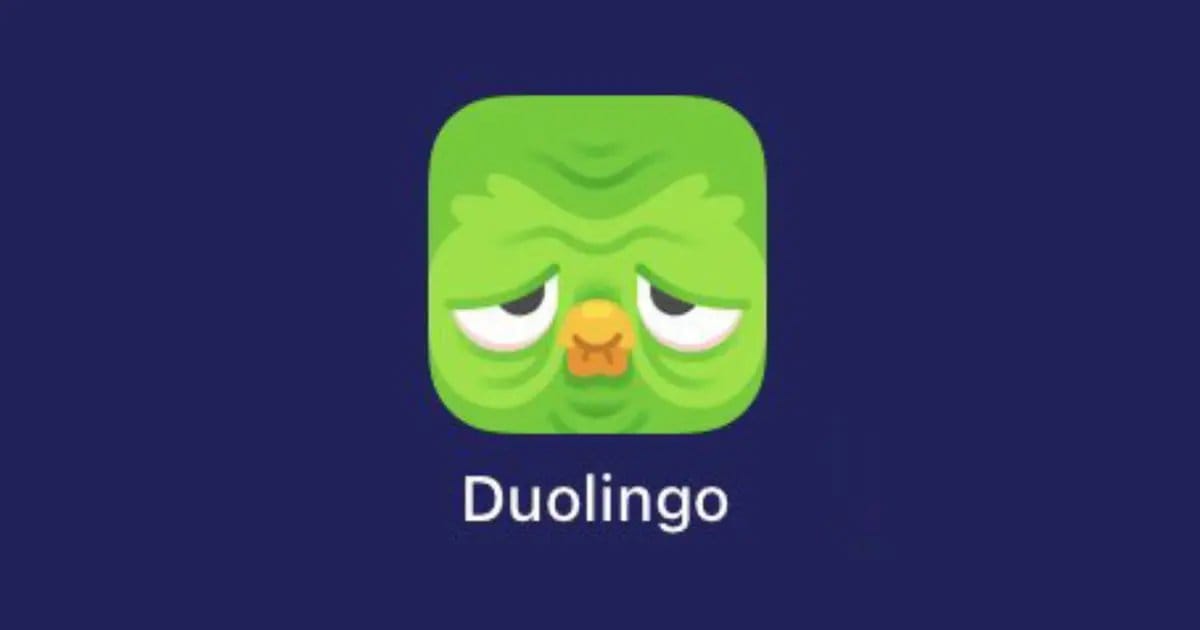
But if you start to slip, the vibes change. The owl doesn't just get angry; it gets depressed. Duolingo famously A/B tested their app icon and found that changing the cheerful bird to a crumpled, crying, depressed owl on users' home screens significantly spiked open rates. They realized that "guilt" was a stronger metric driver than "joy."
Miss a day and your streak freeze keeps you alive. You could even freeze a couple of days. Those freezes are a big part of people returning to the app. If it were a one-and-done scenario, Duolingo would not be a nearly $10B company today.
We got here because Duolingo, in the process of trying to teach language, found they’re better off trying to model addictive apps (like Instagram) rather than language apps like Rosetta Stone. Duolingo can feel fun, just like your social media apps. Learning? Yuck! And it also sucks when you hit a plateau.
They didn't stop at icons. They weaponized their copy. While other apps send generic "We miss you!" notifications, Duolingo's data team found their highest-performing notification was essentially a breakup text: "These reminders don't seem to be working. We’ll stop sending them for now." It’s classic reverse psychology, and it works.
The gamification and streaking built into Duolingo keeps people going long after they’d have typically given up. Duolingo found that loss aversion keeps a user hooked, generally for much longer than people would be willing to learn.
Loss aversion is a concept in behavioral economics that says people hate losing. They hate losing more than they enjoy winning. Put more simply, people will take greater action to avoid loss than they would to gain a win.
I do this all the time. I hate losing more than I like winning. Thinking to stocks - the losers hurt more than the winners help. Thinking to sports betting, it’s the same thing.
Duolingo isn't the only one playing this game. Airlines have 'Status Tiers' that convince rational people to book flights to nowhere just to keep a certain status. Spotify uses 'Wrapped' to turn music listening into a competitive social sport every December. But Duolingo is the only one doing it under the moral cover of 'Education’ at scale.
Streaks are great, and using loss aversion is awesome too, but the problem that many face, including myself, is that short-duration learning of a language isn’t too effective.
Think about it: you’re a kid and you’re learning your first language, how much time are you spending daily listening to and trying to converse in that language? Well, almost all of it. If you’re trying to learn a new language as an adult you’re encouraged to immerse yourself too for several hours a day. Duolingo’s 5 minutes a day means you’re getting about 30 hours a year of learning.
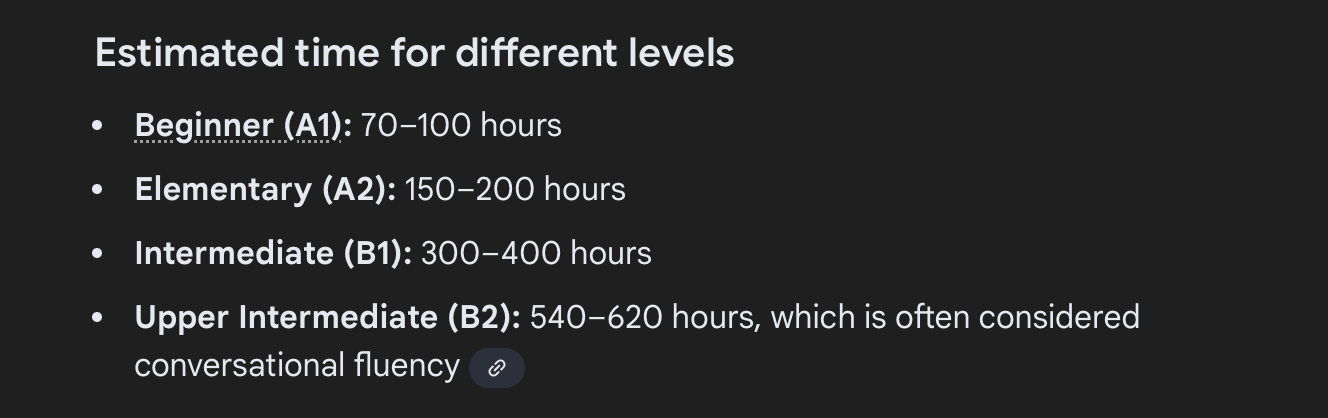
To get to intermediate, a level where you could hold a basic conversation, you’d need 300-400 hours of classroom study, that is 10 years of ground-floor Duolingo.
This isn't an accident. It's a business decision. If Duolingo forced you to do the 30 minutes a day required for fluency, their retention would plummet. They realized that to build a $10B business, they had to optimize for consistency, even if it came at the cost of proficiency. They don't sell fluency; they sell the feeling of progress.
The Hidden Monopoly Duolingo is Taking On
I moved to the U.S. at 17 and enrolled in a small community college. Despite having a British accent that screams "I invented this language," the admissions office didn't see "United Kingdom" on their list of approved countries. They told me I had to take the TOEFL (Test of English as a Foreign Language).
I managed to talk my way out of it, but millions aren't so lucky.
Every year, over 2 million people are forced to take the TOEFL or IELTS to prove they can speak English. It is a miserable, archaic experience. You have to pay ~$200, travel to a physical proctoring center, sit in a room for 3 hours, and wait 10 days for results.
It is a classic "toll booth" business model: High friction, high cost, and zero choice. ETS (the company behind TOEFL) generates over $1 billion a year from this monopoly.
This is the market Duolingo is attacking.
While you were playing with the owl, they built the Duolingo English Test (DET). It is a direct assault on the testing cartel:
- Cost: ~$70 (vs. $200+)
- Speed: Results in 48 hours (vs. 10 days)
- Convenience: Taken from your webcam at home, proctored by AI.
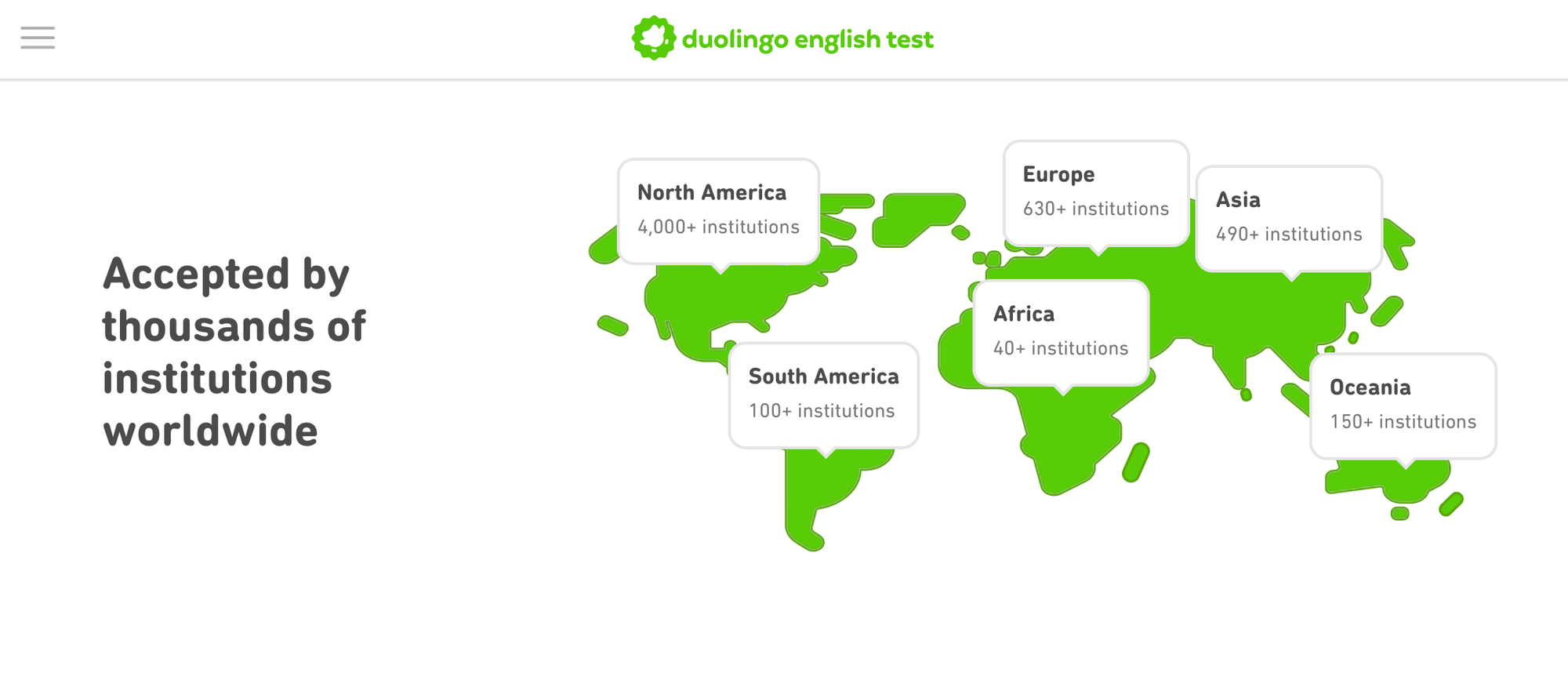
They used the pandemic as a wedge to force adoption. Today, over 6,000 programs (including 98 of the top 100 U.S. universities like Yale and Columbia) accept the DET. This is their "AWS.” A high-margin B2B infrastructure play hidden inside a consumer “toy.”
However, there is a red flag in the data.
In Q3 2025, while the app grew 40%, revenue from the DET actually declined. Independent analysis suggests test volumes dropped by ~17% and revenues dropped ~11%.
The company was quiet about why, but the macro story is clear: the United States is seeing reductions in international students, Canada is restricting student visas, and the UK is also seeing declines. The "Total Addressable Market" for English testing is shrinking for the first time in years.
This leaves Duolingo with a choice: Do they accept that the DET is a niche product? Or do they use this technology to attack other monopolies?
Think about it. Why do we still go to physical centers for Professional Certifications? Why do we take the SATs on paper?
Duolingo has built the world's best "Anti-Cheating AI" infrastructure. If they pivot this technology to proctor any test, not just English, they aren't just an app company anymore. They are the Global Verification Layer for the internet. That is a Bull Case.
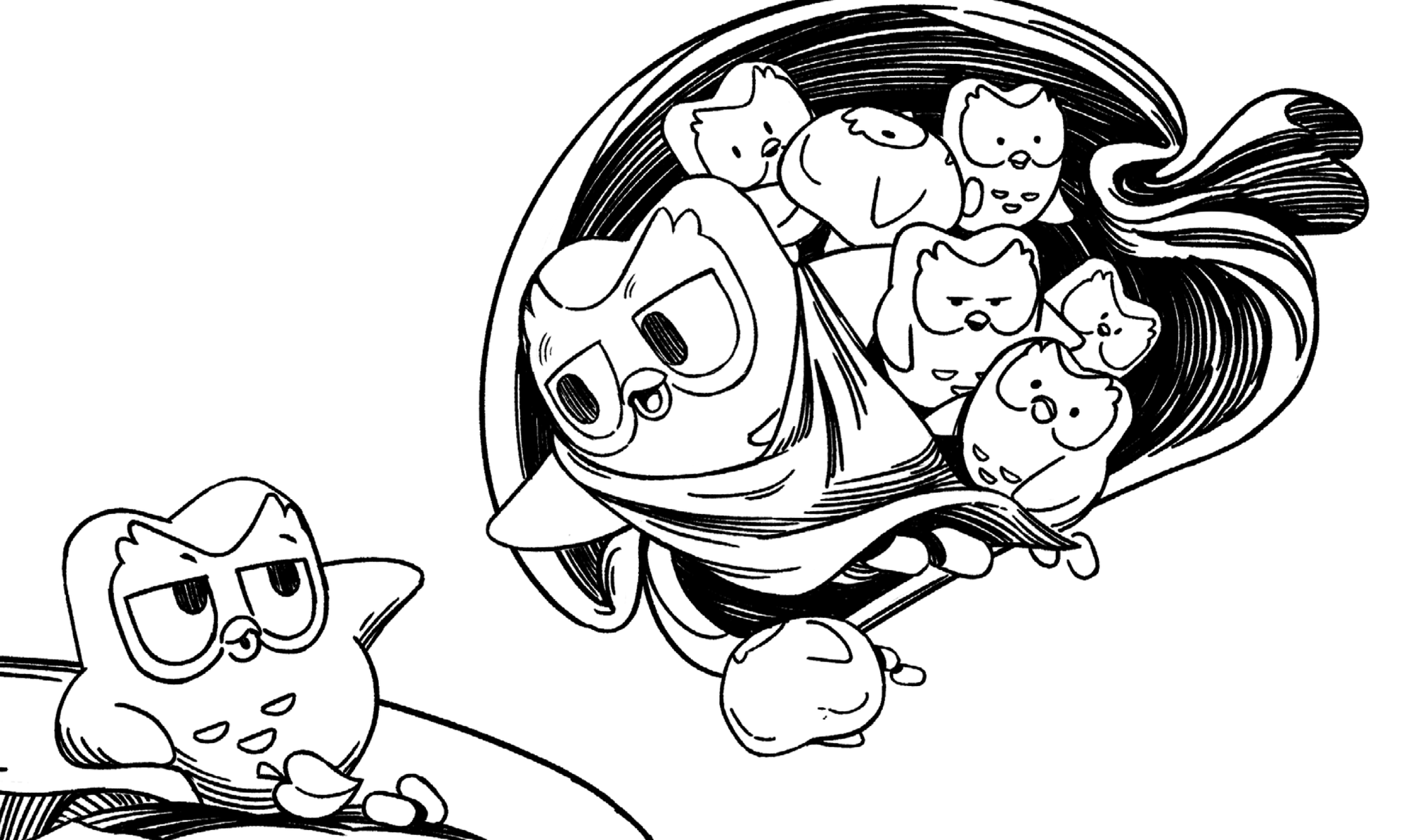
"Unhinged" is not a word I chose. It’s a word Duolingo chose for its own company handbook.
Most corporate marketing is designed by committee to be safe, unremarkable, and instantly forgotten. Duolingo took the opposite approach. They handed their social media keys to a Gen Z team and told them to make the mascot a menace.
“He’s still cute and cuddly. But he’s also willing to temporarily relocate your family to ensure you finish your lessons." — Duolingo Handbook
If you’ve been on the internet in the last three years, you’ve seen it. The gigantic green owl twerking on conference tables, threatening users with legal action, or getting a divorce from Google Translate. It isn't just "funny"; it's a specific strategy called "Community Lore." They treat Duo like a reality TV star, not a logo.
And it prints money.
This strategy has given Duolingo a structural financial advantage that competitors cannot replicate. Because their marketing is "content" that people actually want to watch, their Customer Acquisition Cost (CAC) is effectively zero for millions of users.
Look at the numbers. In Q3 2025, Duolingo spent just 12.9% of its revenue on Sales & Marketing.
Compare that to their "peers":
- Coursera: 34.7%
- Udemy: 41.7%
That gap, the difference between spending 13% and 40% on ads, is pure margin. While competitors are burning cash just to find users, Duolingo is spending that money on R&D and AI. They aren't winning because they have better ads; they are winning because their mascot is a meme that generates 500 million free impressions a year.
The AI Existential Crisis
Up until now, the bull case for Duolingo has been obvious: They hacked the human brain to make us addicted to self-improvement. But we have to talk about the elephant in the room. Or rather, the Babel fish.
In The Hitchhiker’s Guide to the Galaxy, Douglas Adams introduced the Babel fish, “a small, bright yellow fish, which can be placed in someone's ear in order for them to be able to hear any language translated into their first language.”
For forty years, that was sci-fi. Today, it’s a terrifying reality for Duolingo shareholders.
In a world where I can pop in a pair of Google Buds and instantly hear Japanese translated into English, does anyone actually need to learn Japanese?
This is the existential question. And the answer depends on whether you view language as a utility or a hobby.
If language is a Utility, a tool to order a beer or find a bathroom, AI wins. The "survival market" for language learning evaporates overnight.
But consider the calculator. Did we stop teaching math when the pocket calculator arrived? No. But the reason we learned math changed. We stopped learning long division to calculate our taxes and started learning it to understand how numbers work. It shifted from a "tool" to a "cognitive exercise."
The same might happen here. Language learning could move from a "career necessity" to a "brain game," similar to chess. The problem? The market for "career necessities" is massive. The market for "brain games" is niche. If Duolingo becomes "Sudoku for words," their total addressable market (TAM) collapses.
However, Duolingo has a counter-move. They know AI is coming, so they are using it to cannibalize their own costs before it cannibalizes their revenue.
CEO Luis von Ahn recently made headlines for "Founder Mode" ruthlessness, cutting contractors in favor of AI for content generation. This means their cost to produce a new Spanish lesson is trending toward zero.
So the race is on: Can Duolingo use AI to lower their costs faster than AI lowers the demand for their product? To hedge that bet, they are quietly building a new business entirely.
The Final Pivot: University in your Pocket
Duolingo has realized a secret: their proprietary technology isn't "Language Teaching." It is "Habit Formation."
They built a universal gamification engine (Streaks, Leaderboards, Gems) that can be bolted onto any subject that requires repetitive practice. If AI kills the need for French, they simply point the machine at subjects AI cannot kill.
Look closely at their mission statement. It isn't "to teach languages." It is: “To develop the best education in the world and make it universally available.”
Subject agnostic.
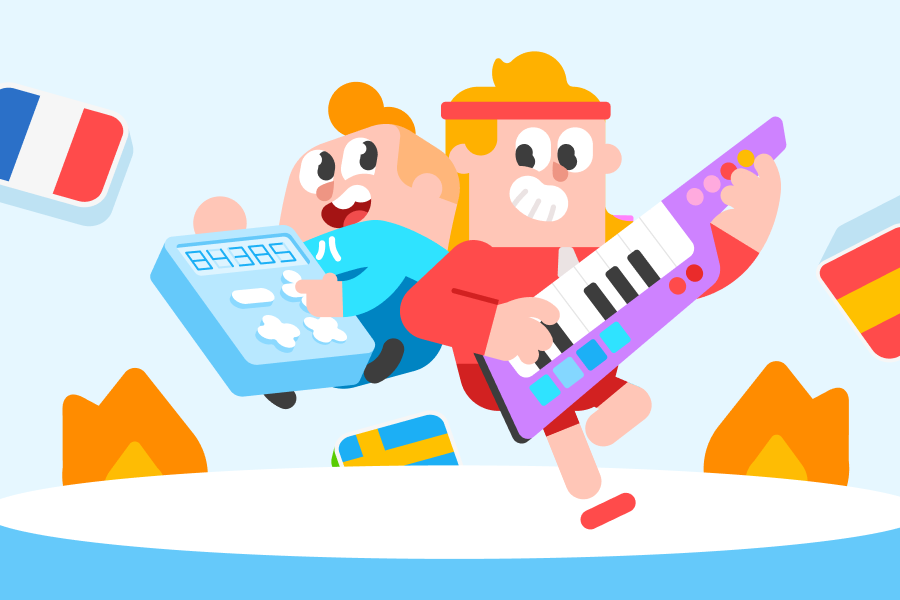
We are already seeing this strategy deploy. In the last 18 months, they have launched Math and Music inside the main app. Why these subjects? Because they fit the "Duolingo Physics":
- They are rule-based (binary right/wrong answers).
- They require drills (daily repetition).
- They are "performance skills" (Knowing how to play piano is cool even if AI can generate music).
The strategic brilliance is the Super App model. They didn't launch a separate "Duolingo Math" app to die in the App Store. They put it in the main feed.
This is a massive financial moat. If you are already addicted to your Spanish streak, you might try a math lesson just for variety. Duolingo acquires that math user for $0. Their competitors (like Khan Academy or MasterClass) have to pay Facebook to find that user.
Without a significant change to how it teaches, Duolingo cannot teach everything (you can't "drill" Philosophy). But they can own the "drill layer" of education: coding, financial literacy, geography, and standardized test prep.
If they pull this off, they aren't just a "language app" fighting Google Translate. They become the "operating system for learning." And that is a company that survives the AI apocalypse.
So, is the stock a buy? Does the "Hidden Monopoly" of the English Test offset the risk of the "Babel Fish"? I’ve modeled out the valuation in the TechBreakdowns Pro deep dive. It'll be released December 15th. Sign up for emails and you'll be notified!
Member discussion